
Chemical Resistant Hose and Chemical Transfer Hose Manufacturer in India
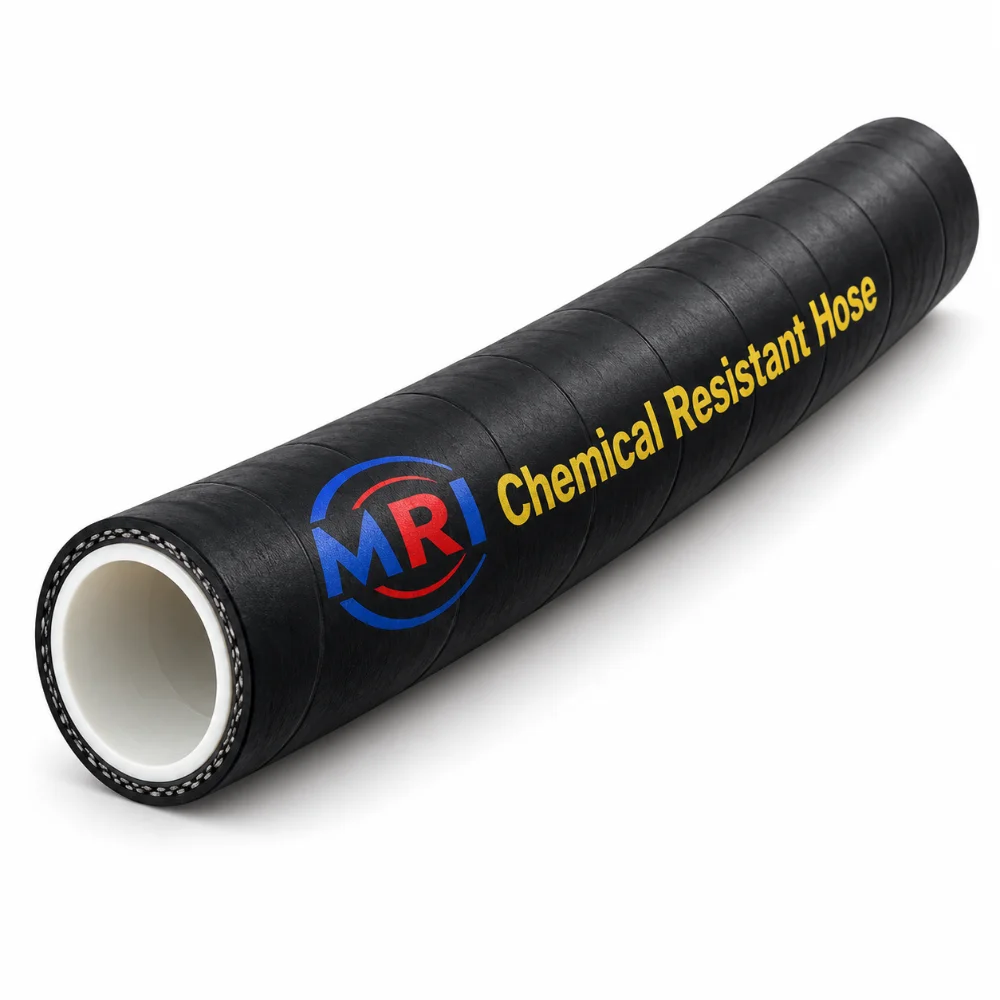
Mangla Rubber Industries manufactures chemical resistant hose and chemical transfer hose in India for acids, alkalis, solvents and corrosive liquids. Supplied with UHMWPE, PTFE, EPDM, CSM (Hypalon) or Viton (FKM) liners, in suction and discharge constructions, as bulk hose or complete assemblies with couplings. Dealer, OEM and plant supply across India and export markets. Manufacturing since 1983.
Get a quote or dealer pricing · Mohit Mangla +91 88007 72816 · Karan Mangla +91 99587 34560 · manglarubberind@gmail.com
Chemical Resistant Hose vs Chemical Transfer Hose
The two terms are used interchangeably, but they describe different emphases. Chemical resistant hose describes the liner: a tube compounded to survive a named chemical at a stated concentration and temperature. Chemical transfer hose describes the duty: moving bulk chemical between tanks, tankers and process units, which adds suction resistance, daily coupling and drag across concrete to the requirement.
In practice a transfer hose must also be chemically resistant, while an in-plant resistant hose may not need suction construction. We build both, and the specification starts the same way: name the chemical, its concentration and the temperature.
Chemical Compatibility Chart by Liner Material
A = recommended · B = acceptable, shorter life · C = limited, test first · X = not recommended. Ratings assume ambient temperature at the stated concentration.
| Chemical | NBR | EPDM | PTFE | UHMWPE | Viton/FKM |
|---|---|---|---|---|---|
| Sulphuric acid 10% | A | A | A | A | A |
| Sulphuric acid 70% | C | A | A | B | X |
| Sulphuric acid 98% | X | C | A | C | X |
| Hydrochloric acid 37% | C | A | A | B | X |
| Nitric acid 10% | B | A | A | A | X |
| Nitric acid 60% | X | B | A | C | X |
| Hydrofluoric acid | C | C | A | C | X |
| Chromic acid | C | A | A | B | X |
| Caustic soda (NaOH) 20% | A | A | A | A | B |
| Ammonia solution | A | A | A | A | B |
| Sodium hypochlorite | B | A | A | A | X |
| Hydrogen peroxide 30% | B | A | A | A | B |
| Acetone | C | X | A | B | X |
| MEK (ketone) | X | X | A | B | X |
| Toluene | X | X | A | B | A |
| Xylene | X | X | A | B | A |
| Benzene | X | X | A | B | A |
| Ethanol / methanol | A | A | A | A | B |
| Diesel and fuel oil | X | B | A | A | A |
| Mineral hydraulic oil | X | B | A | A | A |
| Phosphoric acid 50% | A | A | A | A | B |
| Ferric chloride | A | A | A | A | B |
| Formaldehyde | A | A | A | A | B |
| Ethylene glycol | A | A | A | A | A |
Chemical attack roughly doubles for every 10 °C rise, so a compound rated acceptable at 25 °C may fail within weeks at 80 °C in the same fluid. Treat every B and C as a candidate for a sample test, and send us the concentration and temperature before ordering. A fuller breakdown is in our hose chemical compatibility chart.
Chemical Hose Liner Selection
The liner decides which chemicals a hose can carry. These are the constructions we supply and where each belongs.
| Liner | Best for | Avoid with | Typical max temp |
|---|---|---|---|
| UHMWPE | Widest general range: acids, alkalis, solvents. Usual default for mixed-chemical duty | Strong oxidisers at high concentration | Around 80 °C |
| PTFE | Near-universal resistance plus high temperature. Aggressive acids, pharma and food duty | Molten alkali metals; higher cost, less flexible | Around 200–260 °C |
| EPDM | Caustics, ketones, hot water, steam, dilute acids | Any petroleum product, oils and fuels | Around 150 °C |
| CSM (Hypalon) | Concentrated oxidising acids, hypochlorite bleach, ozone and outdoor service | Aromatic and chlorinated solvents | Around 120 °C |
| Viton / FKM | Oxidising acids, aromatic solvents, fuels, hot oil | Ketones, esters, amines, hot water | Around 200 °C |
Chemical Hose Specifications
| Specification | Detail |
|---|---|
| Inner diameter range | 1/2″ to 4″ (DN12 to DN100) |
| Construction | Discharge, or suction with helical wire for collapse resistance |
| Reinforcement | High-tensile textile or steel wire braid, depending on pressure |
| Cover | Chemical, ozone and abrasion resistant, pin-pricked |
| Safety factor | 4:1 burst to working pressure |
| Couplings | Stainless steel 316, PP or PTFE-lined; camlock, TW, BSP, NPT, flange |
| Temperature range | Liner dependent: up to +260 °C with PTFE |
| Supply | Bulk coils, cut lengths and complete tested assemblies |
Working pressure falls as bore rises and de-rates with temperature. Contact us for the size-wise pressure chart and burst data for your specific application.
Why Plants and Distributors Choose Mangla Chemical Hoses
- Liner matched to your actual fluid: we specify against the chemical, its concentration and the operating temperature, not a generic category.
- Full assemblies, not just hose: supplied with couplings and gaskets in materials compatible with the same fluid, because failures usually start at the fitting.
- Suction and discharge builds: collapse-resistant construction where the line has to lift fluid rather than receive it under pressure.
- Bulk and custom lengths: cut-to-length supply for distributors, plant maintenance teams and OEMs, with volume pricing.
- Manufactured in Ghaziabad, Delhi NCR since 1983, supplying chemical processing, pharmaceutical, textile dyeing, fertiliser, paint and food industries.
Applications
- Acid and alkali transfer in chemical processing plants
- Solvent and dye handling in textile and paint manufacturing
- Tanker loading and unloading, drum and IBC filling
- Pharmaceutical and food-grade transfer where cleanliness is critical
- Effluent treatment, cleaning-in-place and plant washdown lines
- Fertiliser, sugar and distillery process chemical lines
- Electroplating, pickling and surface treatment baths
Couplings and End Fittings
We supply chemical hose as complete assemblies with camlock, TW, BSP, NPT and flanged ends in stainless steel 316, polypropylene or PTFE-lined construction. Every wetted part is selected for the same chemical as the liner, a PTFE-lined hose terminated in mild steel fittings fails at the fitting, not in the tube. Dry-disconnect couplings are available for hazardous media where spillage on uncoupling matters. Tell us the fluid and the connection type and we will confirm the correct combination.
Technical Guides
Chemical resistant hose guide · Chemical transfer hose selection · Chemical compatibility chart · PTFE and Teflon hose · Preventing chemical hose failure
Frequently Asked Questions
What is a chemical resistant hose?
A flexible hose with an inner tube compounded to resist a named chemical at a stated concentration and temperature. Resistance is specific to the compound: NBR, EPDM, CSM, PTFE, UHMWPE or Viton, so a hose resistant to one chemical may fail rapidly in another.
Which hose is best for chemical transfer?
For mixed-chemical duty, UHMWPE resists the widest range and is the usual default. For aggressive acids or high temperature, PTFE is stronger but costs more and is less flexible. For caustics and hot water, EPDM is the economical choice, provided no petroleum is involved.
Can a rubber hose handle acid?
Yes, with the correct compound. EPDM handles dilute acids and alkalis; CSM (Hypalon) handles concentrated oxidising acids such as nitric and chromic acid. NBR should not be used for strong oxidising acids. Always state the acid concentration before specifying.
What is a chemical resistant CSM hose?
A hose with a chlorosulphonated polyethylene (Hypalon) tube. CSM resists concentrated oxidising acids, hypochlorite bleach and ozone better than NBR or EPDM and holds up outdoors, which makes it the standard choice for acid plant and effluent-treatment lines.
What size chemical hose do I need?
Size by flow rate and the pressure your pump actually generates, including surge when a valve closes. Common plant transfer sizes are 1″ to 3″. Tell us the flow rate, pump pressure and run length and we will confirm the bore.
Do chemical hoses need suction construction?
Only if the hose will lift fluid from a tank or strip a line. Without an embedded helix wire a pressure-only hose collapses under vacuum, creases permanently and loses flow capacity.
How often should a chemical hose be replaced?
Replace on a calendar schedule rather than on inspection, because chemical permeation corrodes the reinforcement from the inside with no external sign. Typical practice is one to two years for continuous duty and two to five years for intermittent service.
Do you supply chemical hose to dealers and distributors?
Yes. We supply bulk coils, cut-to-length stock and complete assemblies with volume pricing for dealers, distributors and plant maintenance stores across India, plus export supply.
Get a Quote
Send the chemical name and concentration, the continuous and peak temperature, the working pressure and whether suction is involved, plus bore, length and fitting type. Our engineering team will confirm the liner, construction and lead time. Manufacturing at Plot C-2, Sector B-1, Trans Delhi Signature City, Ghaziabad, Uttar Pradesh 201103.