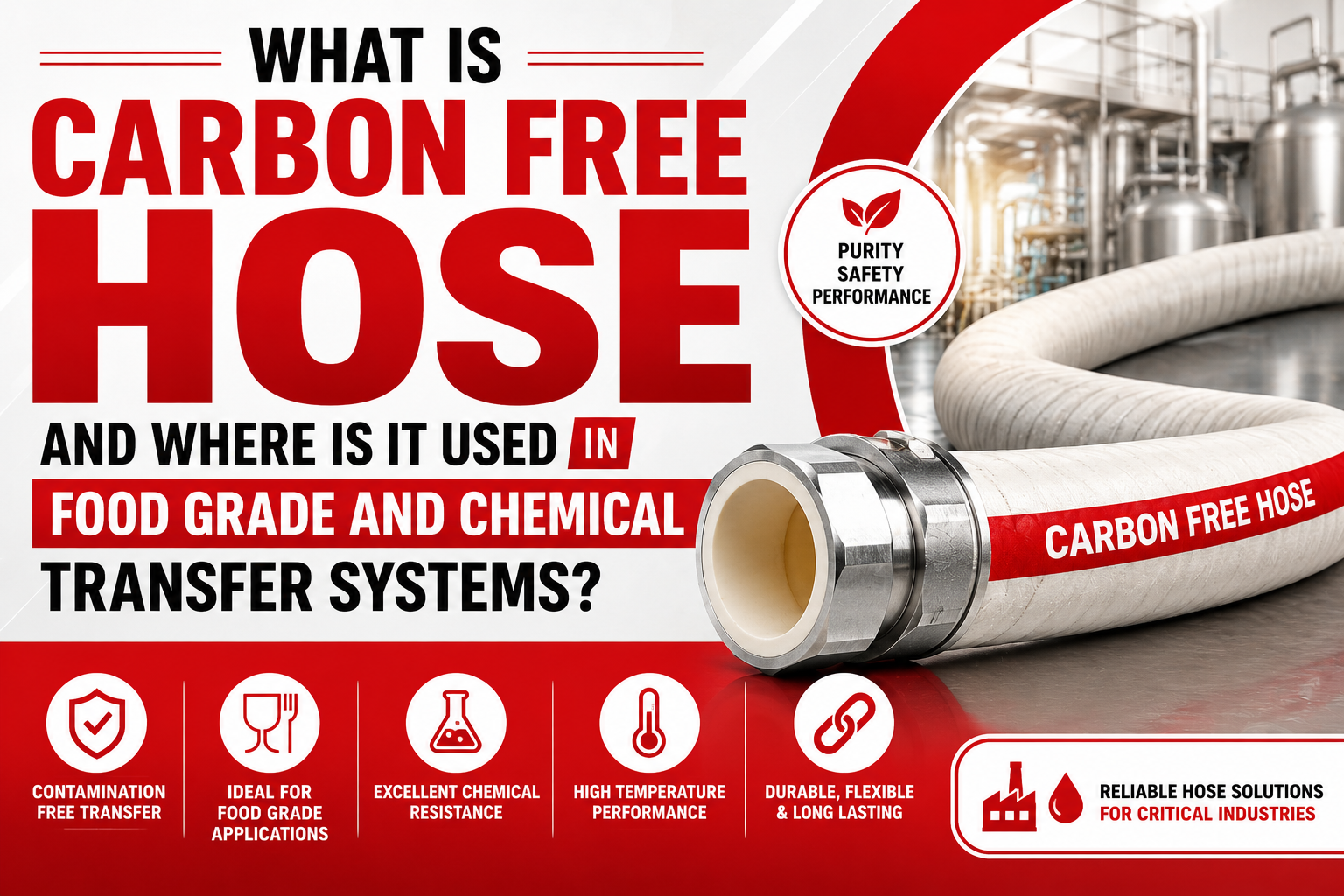
Industrial operations that involve transferring chemicals, food products, pharmaceuticals, or sensitive liquids require hose systems that deliver both performance and product safety. In many of these applications, selecting the wrong hose can lead to contamination, product degradation, equipment damage, or production downtime. This is where a Carbon Free Hose becomes an essential component of industrial fluid transfer systems.
A Carbon Free Hose is specially designed with a non-marking, non-conductive inner tube that does not contain carbon black. This construction helps prevent contamination and makes the hose suitable for industries where cleanliness, product purity, and chemical compatibility are critical. Whether it is used for transferring food ingredients, pharmaceuticals, cosmetics, or specialized chemicals, the right hose ensures consistent performance while maintaining product quality.
Businesses looking to understand industrial hose selection can also explore our detailed guide on Chemical Resistant Rubber Hose in India, which explains how different hose materials are selected for handling aggressive chemicals across industries.
As industries continue to focus on safety standards, hygiene, and operational efficiency, the demand for Carbon Free Hose solutions continues to grow. Understanding where these hoses are used and how they differ from conventional industrial hoses helps buyers make informed purchasing decisions.
What Is Carbon Free Hose?
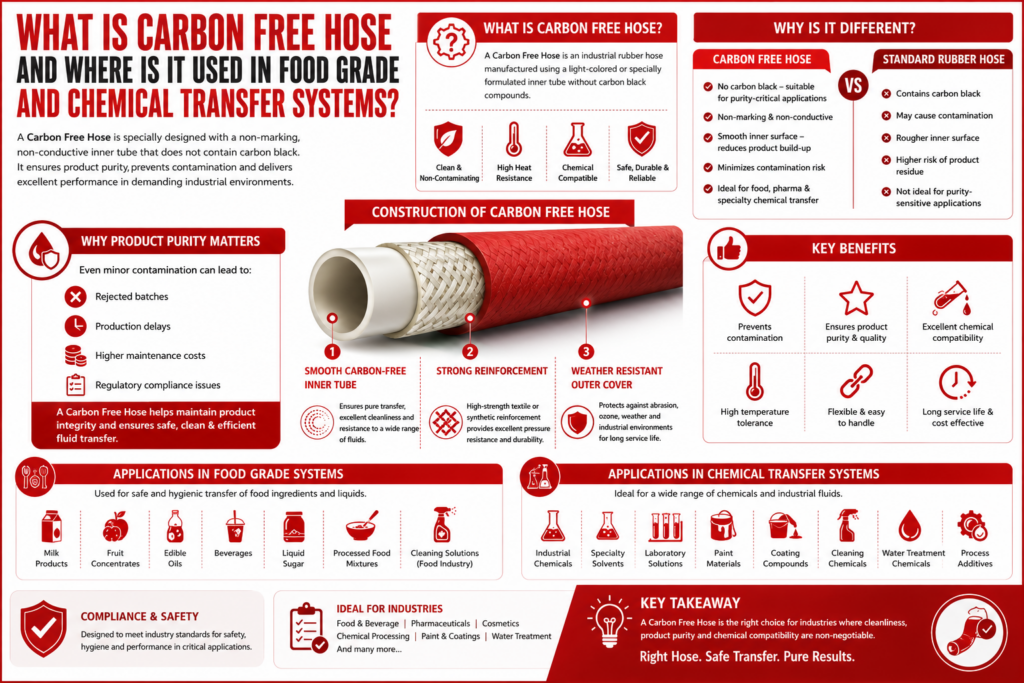
A Carbon Free Hose is an industrial rubber hose manufactured using a light-colored or specially formulated inner tube without carbon black compounds. Since carbon black is commonly used as a reinforcing filler in conventional rubber products, removing it makes the hose suitable for applications where contamination must be avoided.
Unlike standard industrial hoses, a Carbon Free Hose is designed to transfer products that require high purity. It minimizes the risk of carbon residue entering the media being transported while also providing excellent resistance to heat, chemicals, and industrial cleaning processes.
Many industries choose a carbon free hose pipe because it combines flexibility with durability while maintaining hygienic transfer conditions.
Why Is a Carbon Free Hose Different from Standard Rubber Hoses?
Most industrial rubber hoses contain carbon black to improve strength and UV resistance. However, carbon black can become unsuitable when transferring products that require contamination-free environments.
A Carbon Free Hose is manufactured using specialized rubber compounds that offer:
Excellent cleanliness
High resistance to heat
Compatibility with various industrial fluids
Smooth internal surfaces
Reduced contamination risk
Long service life under demanding operating conditions
These characteristics make the hose particularly valuable in food processing plants, pharmaceutical facilities, and chemical manufacturing units.
Why Is Product Purity So Important During Fluid Transfer?
Every production facility works hard to maintain consistent product quality. But what happens if the transfer hose itself introduces contamination into the process?
Even minor contamination can result in rejected batches, production delays, increased maintenance costs, or regulatory compliance issues. This is why many industries invest in high-quality Carbon Free Hose solutions that help maintain product integrity throughout the transfer process.
How Does a Carbon Free Hose Improve Chemical Transfer Safety?
Chemical transfer often involves handling aggressive liquids that can react with unsuitable hose materials. Can an ordinary industrial hose withstand corrosive chemicals without affecting product quality?
A properly selected Carbon Free Hose offers excellent compatibility with many industrial chemicals while maintaining the cleanliness required for specialized applications. Its construction helps reduce the possibility of internal degradation that could affect both equipment and transferred materials.
This makes it an important option for industries working with specialty chemicals, laboratory compounds, solvents, and process fluids.
Applications of Carbon Free Hose in Food Grade Systems
Food manufacturing requires strict adherence to hygiene and safety standards. Every component involved in production, including transfer hoses, plays a role in maintaining food quality.
A Carbon Free Hose is commonly used for transferring:
Liquid food ingredients
Milk products
Fruit concentrates
Edible oils
Beverages
Liquid sugar
Processed food mixtures
Cleaning solutions used in food production
The smooth internal lining helps reduce product build-up while supporting efficient cleaning between production cycles.
Food manufacturers also appreciate the flexibility of a carbon free hose pipe, which simplifies installation and movement around production equipment without compromising durability.
Applications of Carbon Free Hose in Chemical Transfer Systems
Chemical processing facilities work with a wide variety of fluids, each requiring compatible transfer equipment. A Carbon Free Hose performs well in many industrial environments where contamination control is essential.
Typical applications include transferring:
Industrial chemicals
Specialty solvents
Laboratory solutions
Paint manufacturing materials
Coating compounds
Cleaning chemicals
Water treatment chemicals
Process additives
Its resistance to many industrial environments makes it suitable for demanding production facilities that prioritize operational reliability.
Material Construction of a Carbon Free Hose
The performance of a Carbon Free Hose depends on its carefully engineered construction.
Most designs include:
A smooth carbon-free inner tube
High-strength textile or synthetic reinforcement
Weather-resistant outer cover
Abrasion-resistant exterior
Heat-resistant rubber compounds
This combination provides flexibility while maintaining pressure resistance and long operational life.
The exact construction varies depending on the intended application and the type of media being transferred.
Choosing the Right Carbon Free Hose for Your Industry
Selecting the right hose involves more than matching the diameter or pressure rating. Industrial buyers should evaluate several technical factors before making a purchase.
The first consideration is the type of material being transferred. Different chemicals, food products, and pharmaceutical ingredients require specific rubber compounds to maintain compatibility.
Operating temperature is equally important. Some production processes involve elevated temperatures that demand hoses capable of maintaining structural integrity without affecting product quality.
Pressure requirements should also be carefully reviewed. A hose designed for low-pressure food transfer may not be suitable for high-pressure industrial chemical applications.
Flexibility, bend radius, cleaning procedures, and regulatory compliance should all be considered before selecting a Carbon Free Hose.
Working with experienced chemical hose manufacturers can simplify this process and help ensure the selected hose meets the operational requirements of your facility.
Working with Reliable Carbon Free Hose Manufacturer in India
Choosing the right supplier is just as important as selecting the right hose. A trusted Carbon Free Hose solution should be backed by consistent manufacturing standards, quality testing, and technical support.
An experienced carbon free hose manufacturer in india understands the operational challenges faced by industries such as food processing, pharmaceuticals, chemical manufacturing, and industrial processing. They can recommend hose specifications based on the type of media being transferred, operating pressure, temperature, and application environment.
Manufacturers with strong quality control processes also ensure that every hose meets industry requirements for durability, flexibility, and long-term performance. This reduces the risk of unexpected failures and helps businesses maintain uninterrupted operations.
Why Quality Matters in Chemical Hose Applications
A Carbon Free Hose is often used alongside other industrial hose products depending on the application. For chemical transfer systems, selecting the appropriate chemical hose is equally important because different chemicals react differently with hose materials.
Poor-quality hoses may experience swelling, cracking, hardening, or internal degradation over time. These issues not only reduce hose life but can also lead to contamination, leakage, and costly downtime.
Businesses that regularly handle corrosive liquids should work with established chemical hose suppliers who understand chemical compatibility and can recommend suitable hose constructions for specific industrial applications.
The Importance of Proper Installation and Maintenance
Even the highest-quality Carbon Free Hose requires proper installation and routine maintenance to deliver reliable performance.
Hoses should never be twisted during installation, as excessive stress can reduce service life. The bend radius should always remain within the manufacturer’s recommended limits to prevent internal damage.
Regular inspections help identify early signs of wear such as surface cracks, abrasion, blistering, or loose connections. Replacing worn hoses before failure reduces safety risks and prevents unplanned production interruptions.
Cleaning procedures should also match the hose material and the products being transferred. This is particularly important in food and pharmaceutical environments where hygiene standards must be maintained throughout the production process.
How Chemical Hoses and Fittings Improve System Performance
A transfer system is only as reliable as its weakest component. While selecting the correct Carbon Free Hose is essential, compatible chemical hoses and fittings are equally important for ensuring safe and leak-free operations.
Properly matched fittings provide secure connections, reduce pressure loss, and minimize the possibility of leakage during chemical transfer. High-quality fittings also simplify maintenance and improve the overall efficiency of industrial fluid handling systems.
When hoses and fittings are selected together based on application requirements, businesses benefit from improved safety, longer equipment life, and more dependable production processes.
Why Businesses Choose Mangla Rubber Industries
Industrial buyers look for more than just a product. They need a supplier that understands application requirements and delivers reliable hose solutions for demanding environments.
Mangla Rubber Industries manufactures industrial hose solutions designed for sectors including food processing, pharmaceuticals, chemical processing, manufacturing, construction, and engineering. Every application requires careful consideration of operating conditions, and selecting the right Carbon Free Hose helps businesses maintain product quality while supporting safe and efficient operations.
Final Thoughts
Selecting the right Carbon Free Hose is an important decision for industries where cleanliness, product purity, and reliable fluid transfer cannot be compromised. Whether used in food processing, pharmaceutical manufacturing, or chemical handling, these hoses help maintain product integrity while supporting safe and efficient industrial operations.
Understanding the application, operating conditions, and material compatibility allows businesses to choose the most suitable hose for long-term performance. Working with experienced carbon free hose manufacturer in india, trusted chemical hose manufacturers, and reliable chemical hose suppliers further ensures that every transfer system meets the required standards for quality and safety.
As industrial processes continue to demand higher levels of performance and contamination control, investing in the right Carbon Free Hose solution remains a practical step toward improving productivity and maintaining consistent operational standards.
For industry updates, new product information, and practical insights on industrial hose solutions, follow Mangla Rubber Industries on LinkedIn.
FAQs
1. What is a Carbon Free Hose used for? A Carbon Free Hose is used to transfer products that require contamination-free handling, including food ingredients, pharmaceutical products, specialty chemicals, cosmetics, and laboratory fluids.
2. Why is a carbon free hose pipe preferred in food processing? A carbon free hose pipe helps reduce the risk of contamination because its inner tube does not contain carbon black, making it suitable for hygienic applications where product purity is essential.
3. How do I choose the right Carbon Free Hose? Consider the type of media being transferred, operating pressure, temperature, chemical compatibility, hose size, flexibility, and compliance requirements. Consulting an experienced carbon free hose manufacturer in india can help you select the appropriate hose.
4. Can a Carbon Free Hose be used for chemical transfer? Yes. A Carbon Free Hose is widely used in many chemical transfer applications where cleanliness and compatibility are important. The exact suitability depends on the chemical being handled and the hose specifications.
5. Why should I purchase from experienced chemical hose manufacturers? Established chemical hose manufacturers provide technically tested products, consistent quality, application guidance, and reliable performance. They also help businesses select compatible chemical hoses and fittings for safe and efficient industrial operations.