The industrial landscape of 2026 is no longer defined just by heavy machinery and iron gears, but by the intelligence embedded within them. Among the most transformative advancements is the rise of the Smart Industrial Hose. Once considered a passive component for fluid transfer, the Smart Industrial Hose has evolved into a critical data-gathering asset that ensures safety, efficiency, and zero-downtime operations.
What Makes a Hose "Smart"?
In 2026, a Smart Industrial Hoses is defined by its ability to “feel” and “communicate.” Unlike traditional reinforced rubber tubes, these advanced assemblies are embedded with IoT sensors and conductive layers that monitor internal and external conditions in real-time.
The integration of these technologies allows a Smart Industrial Hose to track:
Pressure Fluctuations: Detecting surges before they lead to catastrophic bursts.
Temperature Extremes: Monitoring fluid heat to prevent material degradation.
Flow Velocity: Ensuring optimal throughput for precision manufacturing.
Integrity & Wear: Identifying thinning walls or internal abrasions using conductive filaments.
Key Innovations Driving the Industry in 2026
The leap from 2024 to 2026 has introduced several “cutting-edge” features that have made the Smart Industrial Hose a staple in modern factories.
1. AI-Powered Predictive Maintenance
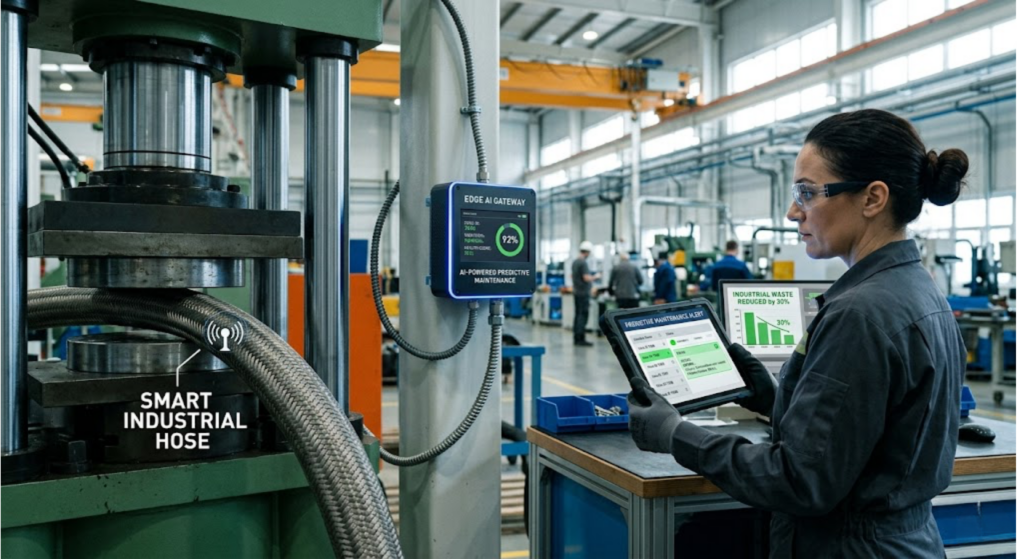
The most significant innovation is the shift from reactive to predictive maintenance. Every Smart Industrial Hose now feeds data into localized AI edge gateways. Instead of replacing a hose on a fixed schedule—which often leads to wasting perfectly good equipment—operators receive alerts only when a Smart Industrial Hose shows actual signs of fatigue. This “Health Score” system has reduced industrial waste by 30%.
2. Self-Healing Polymer Layers
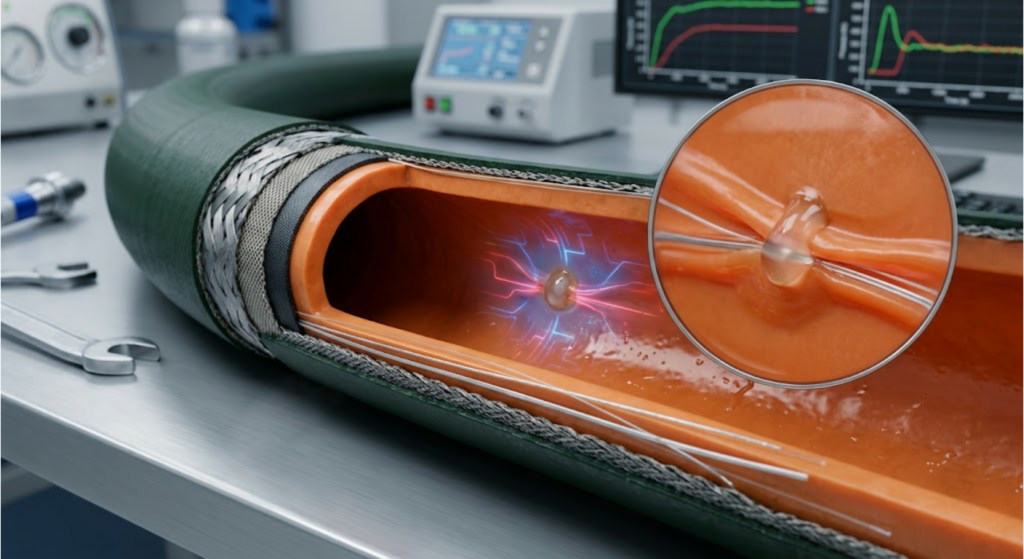
Materials science has caught up with digital tech. Some premium Smart Industrial Hose models now feature inner linings made of self-healing elastomers. If a micro-puncture occurs, the chemical composition of the hose reacts to the pressure change, temporarily sealing the leak until a controlled maintenance window can be scheduled.
3. Energy-Harvesting Sensors
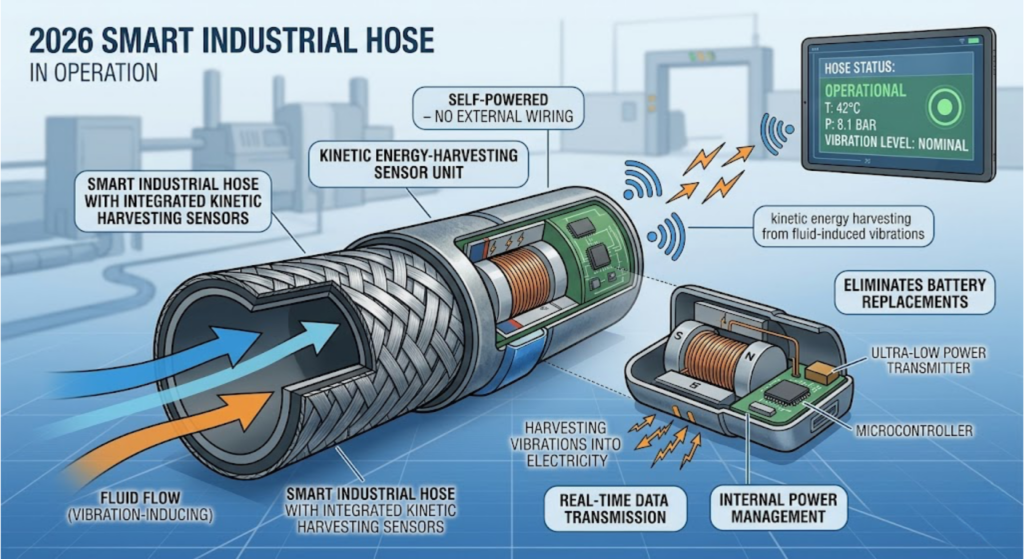
One of the hurdles of early IoT hoses was battery life. In 2026, a Smart Industrial Hose often utilizes “kinetic energy harvesting.” By capturing the vibrations of the fluid moving through the tube, the sensors power themselves, eliminating the need for external wiring or battery replacements.
Critical Uses Across Key Sectors
The versatility of the Smart Industrial Hose has made it indispensable across various high-stakes industries:
| Industry | Primary Use Case for Smart Industrial Hose | Key Benefit |
|---|---|---|
| Oil & Gas | High-pressure offshore fluid transfer | Prevention of environmental leaks |
| Pharmaceuticals | High-purity chemical routing | Real-time contamination & temperature monitoring |
| Food & Beverage | Transfer of perishable liquids | Automated cleaning-in-place (CIP) validation |
| Steel Manufacturing | Hydraulic systems for blast furnaces | Fire-resistant monitoring in extreme heat |
The Economic Impact: Why Invest?
For a procurement manager, the initial cost of a Smart Industrial Hose is higher than a standard one. However, the ROI is realized through the avoidance of “The Big Stop.” In a high-volume manufacturing plant, a single hour of unplanned downtime can cost upwards of $50,000. By using a Smart Industrial Hose, companies can effectively eliminate hose-related failures.
Furthermore, the Smart Industrial Hoses helps businesses meet 2026 ESG (Environmental, Social, and Governance) targets. By preventing leaks of hazardous chemicals and reducing the frequency of hose replacements, companies significantly lower their environmental footprint.
Future Outlook: Beyond 2026
As we look past 2026, the Smart Industrial Hose is expected to integrate further with “Digital Twin” technology. Engineers will be able to run simulations on a virtual version of their piping system, using real-time data from every Smart Industrial Hoses in the building to predict how changes in production speed will affect the physical infrastructure
Conclusion
The Smart Hose is no longer a futuristic concept; it is the backbone of the resilient, data-driven factory of 2026. By embracing the Smart Hoses, industries are moving toward a safer, more sustainable, and infinitely more efficient future. If your facility hasn’t yet integrated a Smart Hoses into its critical pathways, you aren’t just behind the curve—you’re risking the flow of your entire operation.