
Navigating the Future: The Essential Role of Flexible Rubber Hoses in 2026 Industrial Applications
As we move through 2026, the industrial landscape is evolving at a breakneck pace. From the automation of manufacturing floors to the expansion of green energy infrastructure, the demand for reliable fluid and gas transfer systems has never been higher. At the heart of these systems, ensuring efficiency and safety, are Flexible Rubber Hoses.
While they might seem like simple components, modern Flexible Rubber Hoses are highly engineered tools. In 2026, the global market for industrial hose assemblies is projected to reach over $25 billion, with Flexible Rubber Hosesaccounting for nearly 60% of that demand. This dominance isn’t accidental; it’s driven by their unmatched versatility in extreme environments.
The Anatomy of a Modern Industrial Hose
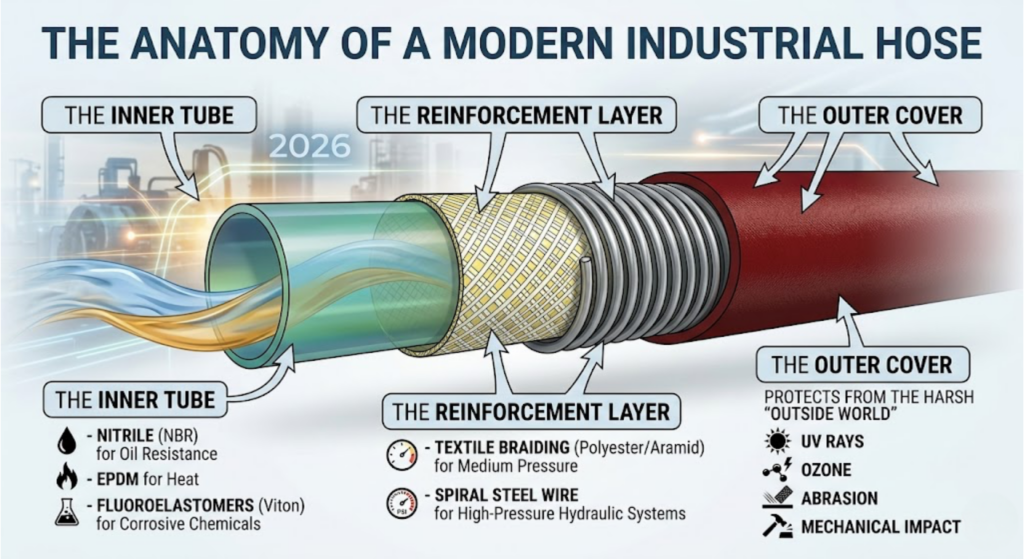
To understand why Flexible Rubber Hoses remain the industry standard, we have to look at their construction. A high-performance hose in 2026 is a “sandwich” of specialized materials designed to survive where others fail.
The Inner Tube: This is the primary contact point for the media being transported. Depending on the application, engineers use Nitrile (NBR) for oil resistance, EPDM for heat, or high-performance Fluoroelastomers (Viton) for corrosive chemicals.
The Reinforcement Layer: This provides the “backbone.” For medium-pressure tasks, manufacturers use textile braiding (polyester or aramid). For high-pressure hydraulic systems, spiral steel wire reinforcement is the go-to, allowing Flexible Rubber Hoses to handle thousands of PSI without bursting.
The Outer Cover: This layer protects the hose from the harsh “outside world”—UV rays, ozone, abrasion, and mechanical impact.
Key Industrial Applications in 2026
Flexible Rubber Hoses are the unsung heroes across multiple sectors. Here is how they are being utilized today:
Manufacturing & Automation: In smart factories, Flexible Rubber Hoses provide the pneumatic and hydraulic power required for robotic arms. Their ability to withstand “cyclic loading”—repeated bending and stretching—is critical for 24/7 operations.
Oil, Gas, & Mining: In the extraction industries, hoses must endure abrasive slurries and high-pressure drilling fluids. The flexibility of rubber allows these conduits to navigate the tight, vibrating spaces of heavy machinery.
Chemical & Pharmaceuticals: Precision is everything here. Specialized Flexible Rubber Hoses ensure that volatile or ultra-pure chemicals are transferred without contamination or leakage.
Construction: From concrete pumping to air compressors, the durability of Flexible Rubber Hoses on rugged jobsites prevents costly downtime.
Innovation: The Rise of "Smart" Flexible Rubber Hoses
The biggest trend in 2026 is the integration of safety technology directly into the hose assembly. “Smart Hose” systems now feature internal valving designed to eliminate hazardous spills. If a catastrophic failure occurs—such as a coupling blow-off or a clean cut—these internal valves instantly shut off the flow in both directions.
This innovation in Flexible Rubber Hoses significantly reduces the risk of “hose whipping,” which can cause severe injury or property damage. For industries handling high-pressure gases or toxic liquids, these safety-integrated Flexible Rubber Hoses are becoming a regulatory requirement rather than an optional upgrade.
Selection and Maintenance: Maximizing Your Investment
Choosing the right Flexible Rubber Hoses isn’t just about the price; it’s about the “STAMPED” method (Size, Temperature, Application, Media, Pressure, Ends, and Delivery).
| Feature | Importance in 2026 |
|---|---|
| Bend Radius | Crucial for compact robotic cells to prevent kinking. |
| Temperature Range | Modern EPDM hoses can now handle steam exceeding 200°C. |
| Chemical Compatibility | Ensures the inner tube doesn’t degrade or leach into the product. |
Maintenance Tip: Even the best Flexible Rubber Hoses have a finite lifespan. In 2026, predictive maintenance is the standard. Inspect your hoses every 400 to 600 hours of use for cracks, bulges, or leaks. Storing Flexible Rubber Hoses in cool, dry areas away from direct sunlight can extend their service life by up to 30%.
Why Rubber Still Wins in 2026
Despite the rise of thermoplastics, Flexible Rubber Hoses remain the leader because of their superior “memory” (the ability to return to their original shape) and their vibration-dampening qualities. In an industrial world that is getting faster and louder, the natural resilience of rubber provides a level of reliability that synthetic substitutes often struggle to match.
Whether you are upgrading a manufacturing line or maintaining a mining fleet, investing in high-quality Flexible Rubber Hoses is an investment in your facility’s safety and operational efficiency. As we look toward the rest of 2026 and beyond, these flexible lifelines will continue to keep the wheels of industry turning.