In the fast-paced world of 2026, the global food and beverage sector has moved beyond simple production into an era of high-speed automation and hyper-traceability. Central to this evolution is a critical, yet often overlooked component: the Rubber Hoses for Food Processing Industry. As production lines become more continuous and rigorous, the demand for high-performance, compliant, and “smart” transfer solutions has never been higher.
This year, the market for Rubber Hoses for Food Processing Industry is projected to reach a valuation between $2.1 billion and $3.8 billion. This growth is driven not just by volume, but by a shift toward premium, specialized materials that ensure consumer safety and operational longevity.
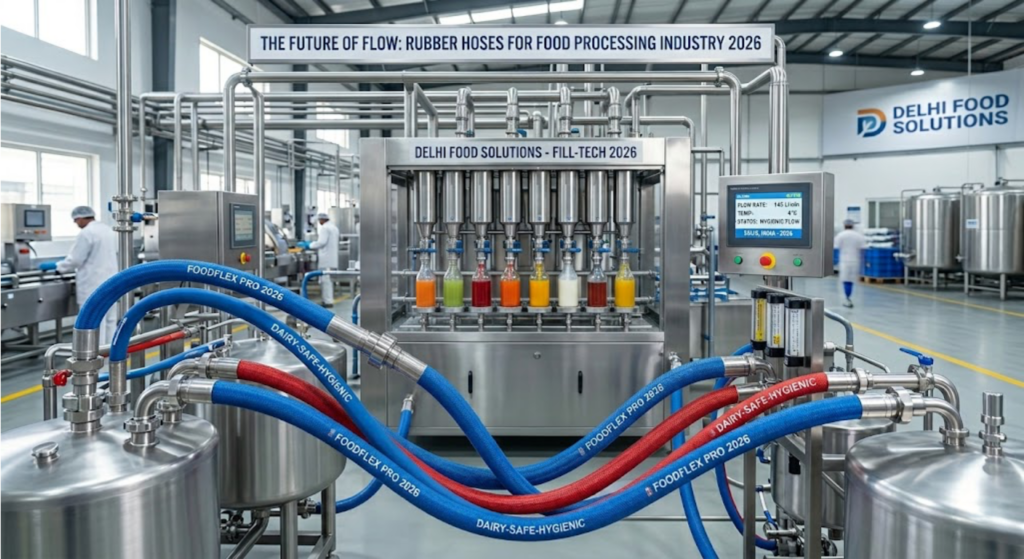
1. Material Innovation: Beyond Standard Rubber
In 2026, “food-grade” is no longer a monolith. Manufacturers are tailoring the inner liners of Rubber Hoses for Food Processing Industry to specific food groups to prevent flavor leaching and chemical migration.
Dairy Applications: High-fat content can degrade standard rubber. Modern nitrile (NBR) hoses are now engineered for maximum oil resistance and can withstand the daily thermal shock of steam cleaning (165∘C and above).
Brewing & Distilling: To preserve the organoleptic properties of premium spirits and craft beers, specialty bromobutyl or chlorobutyl liners are the gold standard. These materials are inert, ensuring no “rubbery” taste enters the product.
Acidic Foods: For juices and soft drinks, EPDM (Ethylene Propylene Diene Monomer) is favored for its exceptional resistance to organic acids and high-temperature sanitization.
2. The Rise of "Smart" Hoses
One of the most significant trends in 2026 for the Rubber Hoses for Food Processing Industry is the integration of digital tracking. Industry leaders like Trelleborg and Continental are now embedding RFID tags and sensors directly into the hose carcass.
These smart systems allow quality managers to track:
Cleaning Cycles: Automatically logging every Clean-in-Place (CIP) or Sterilization-in-Place (SIP) event.
Service Life: Real-time monitoring of wear and tear to prevent catastrophic hose failures.
Traceability: Instantly verifying FDA or EU 10/2011 compliance during safety audits.
3. Regulatory Compliance: Meeting 2026 Standards
Navigating the regulatory landscape for Rubber Hoses for Food Processing Industry is more complex than ever. In 2026, global standards have converged, requiring hoses to be free of phthalates, BPA, and heavy metals.
| Standard | Focus Area | Requirement for 2026 |
|---|---|---|
| FDA 21 CFR 177.2600 | Rubber Articles | Migration testing for fatty and aqueous foods. |
| EU Reg. 10/2011 | Plastic & Elastomers | Strict limits on specific migration of additives. |
| USP Class VI | Biocompatibility | Required for high-purity infant formula and pharma-food. |
| 3-A Sanitary | Design Standards | Smooth-bore interiors to prevent bacterial “biofilms.” |
By choosing the right Rubber Hoses for Food Processing Industry, facilities avoid the risk of contamination and expensive product recalls, which have become increasingly scrutinized by 2026 digital consumer watchdogs
4. Sustainability and "Green" Rubber
Environmental impact is a top-tier priority this year. Many companies are moving away from traditional vulcanized rubber in favor of Thermoplastic Elastomers (TPE). These materials offer the flexibility of rubber but are fully recyclable. Furthermore, the manufacturing of Rubber Hoses for Food Processing Industry has become more eco-efficient, utilizing “curing-free” processes that reduce energy consumption and carbon footprints by up to 15%.
5. Maintenance and Durability: The CIP/SIP Factor
In 2026, downtime is the enemy of profitability. The Rubber Hoses for Food Processing Industry must handle aggressive cleaning chemicals without losing structural integrity.
Reinforcement: Most high-pressure hoses now feature double-wire braiding or galvanized steel helices to prevent vacuum collapse and kinking.
Outer Covers: Modern covers are designed to be “fat-resistant” and “ozone-resistant,” meaning they won’t crack even when exposed to greasy floors or UV light in outdoor loading bays.
Conclusion: Investing in the Right Flow
The Rubber Hoses for Food Processing Industry are the arteries of the modern production facility. Choosing the right hose in 2026 involves balancing material science, regulatory compliance, and new digital technologies. Whether you are transferring 96% proof alcohol or viscous dairy concentrates, your choice of Rubber Hoses for Food Processing Industry directly impacts your product’s purity and your plant’s efficiency.