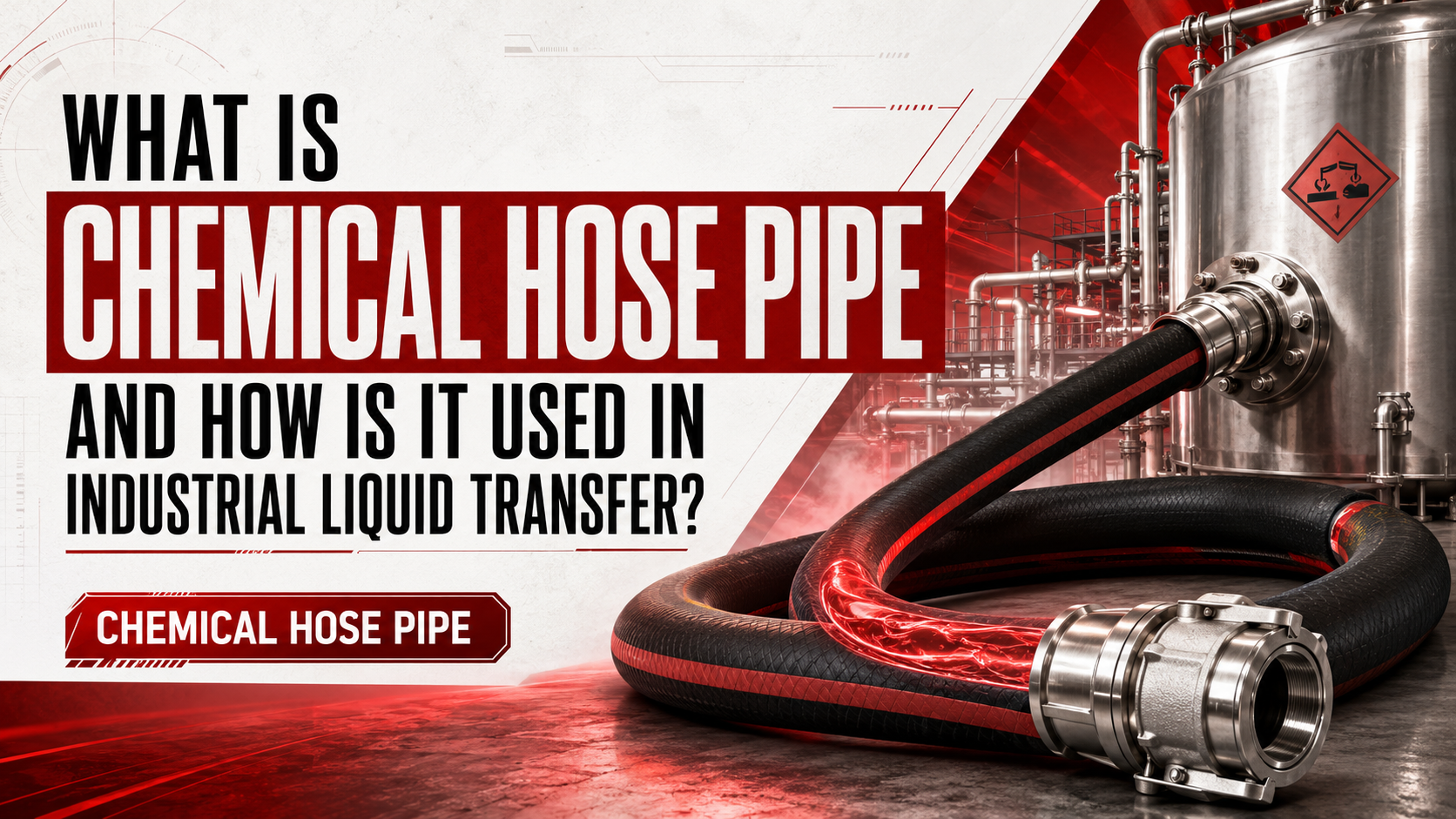
Industrial liquid transfer is not simply about moving a fluid from one point to another. The nature of the chemical, operating pressure, temperature, installation environment, and hose construction all influence the safety of the process. A regular rubber hose may perform well with water or air, but it can deteriorate quickly when exposed to acids, solvents, alkalis, oils, or other aggressive substances. This is where a Chemical Hose Pipe becomes essential.
A Chemical Hose Pipe is specially designed to transfer industrial chemicals without allowing the inner tube to soften, crack, swell, or react with the conveyed material. It is commonly used in chemical processing plants, pharmaceutical facilities, refineries, paint factories, tanker loading stations, and industrial cleaning systems. When selected correctly, a Chemical Resistant Hose helps maintain reliable flow while reducing leakage, contamination, and workplace safety risks.
What Is a Chemical Hose Pipe?
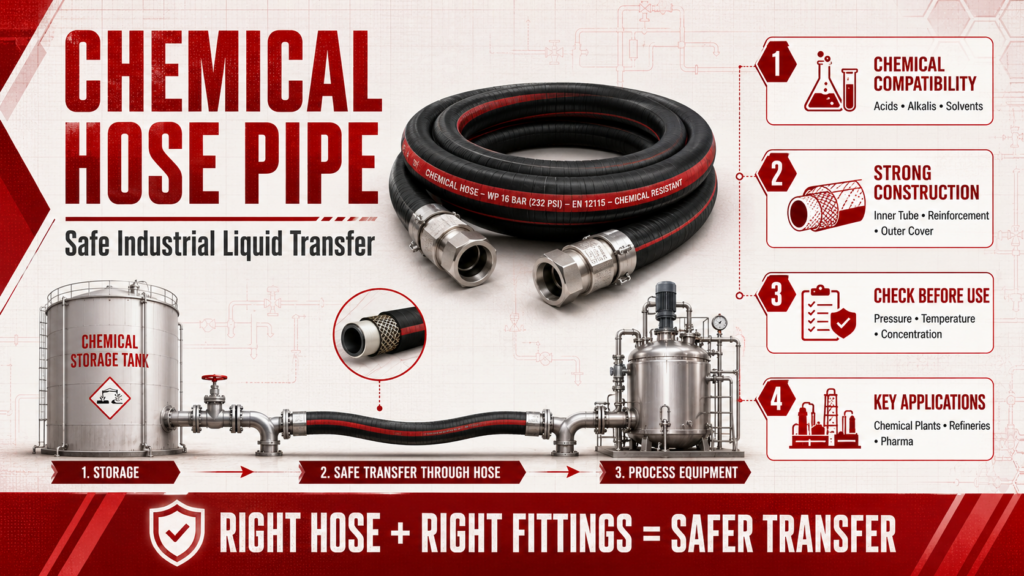
A Chemical Hose Pipe is an industrial hose manufactured from materials that can withstand contact with specific chemicals. Its inner lining may be made from EPDM, UHMWPE, XLPE, PTFE, synthetic rubber, or another compatible material. The choice depends on the chemical being transferred and the conditions under which the hose will operate.
The inner tube provides chemical resistance, while reinforcement layers give the hose strength against internal pressure and external stress. The outer cover protects it from abrasion, weather, ozone, oil, and physical damage. Depending on the application, a Chemical Hose may also contain textile reinforcement, high-tensile steel wire, or an anti-static layer.
Unlike an ordinary industrial hose, a Chemical Hose Pipe must be selected after checking the exact chemical concentration, temperature, pressure, and expected contact time. Two chemicals belonging to the same broad category can affect hose materials differently. This is why chemical compatibility should never be assumed.
Why Can an Ordinary Rubber Hose Not Be Used for Chemical Transfer?
An ordinary hose may look strong from the outside, but its internal lining might not tolerate aggressive liquids. Chemical exposure can cause swelling, hardening, blistering, cracking, or separation of the hose layers. Such damage can restrict flow and eventually lead to leakage or sudden hose failure.
A suitable Chemical Resistant Hose is engineered to remain stable when exposed to compatible acids, alkalis, solvents, alcohols, and other industrial fluids. It also helps protect the transferred liquid from contamination caused by deteriorating hose material.
Using the wrong hose may initially appear to reduce costs, but the consequences can include product loss, equipment damage, production downtime, environmental contamination, and worker exposure. A properly selected Chemical Hose Pipe offers better value because it supports safer operation and a longer service life.
How Does a Chemical Hose Pipe Handle Industrial Liquids Safely?
Safe chemical transfer begins at the hose’s inner surface. The lining of a Chemical Hose Pipe acts as a barrier between the liquid and the reinforcement layers. If the lining is chemically compatible, it remains stable and prevents the liquid from penetrating deeper into the construction.
Reinforcement controls hose expansion and allows it to handle the required working pressure. The external cover protects the assembly from dragging, weather, accidental contact, and industrial wear. For applications involving flammable liquids, a conductive or anti-static Chemical Hose may be required to dissipate static electricity.
The performance of the assembly also depends on suitable Chemical Hose Fittings. A compatible hose connected to the wrong coupling can still leak or separate under pressure. The hose, fitting, clamp, gasket, and sealing material must therefore be treated as a complete transfer system.
Major Industrial Applications
Chemical manufacturing plants use a Chemical Hose Pipe to move raw materials, intermediate compounds, acids, and cleaning solutions between tanks and processing equipment. Flexibility makes the hose useful where rigid pipelines cannot accommodate equipment movement or temporary connections.
In tanker loading and unloading operations, chemical hoses and fittings connect storage tanks with road tankers, drums, and transfer pumps. These assemblies must handle repeated movement while maintaining a secure connection. Their condition should be inspected before every transfer operation.
Pharmaceutical and cosmetic plants use specialised hoses where cleanliness and contamination control are important. Paint, ink, adhesive, and coating manufacturers require hose materials capable of handling solvents, pigments, and chemical mixtures. Refineries and petrochemical facilities may use a Chemical Resistant Hose for selected oils, fuels, additives, and processing fluids after compatibility has been confirmed.
Water treatment plants also depend on Chemical Hose Pipe assemblies for transferring dosing chemicals, cleaning compounds, and treatment solutions. In every application, the hose must be selected for the actual fluid rather than only the name of the industry.
Important Factors in Chemical Hose Selection
Chemical compatibility is the first consideration. The complete chemical name, concentration, and composition should be shared with the manufacturer or supplier. A hose suitable for a diluted chemical may not be suitable for the same substance at a higher concentration.
Temperature is equally important because heat can accelerate chemical attack. A Chemical Hose Pipe that performs reliably at room temperature may lose strength when the liquid temperature rises. Both the temperature of the fluid and the surrounding environment should be considered.
Working pressure, pressure surges, vacuum conditions, and bending requirements must also be evaluated. The selected hose should have an appropriate safety margin, but it should never be operated beyond its stated working pressure. If suction is involved, the construction must be capable of resisting collapse.
The required internal diameter affects flow rate and pressure loss. A hose that is too narrow may restrict flow and place unnecessary load on the pump. A hose that is unnecessarily large may be difficult to handle and install.
Reliable Chemical Hose Manufacturers review these operating details before recommending a product. Experienced chemical hose suppliers should also provide information about compatibility, pressure rating, temperature range, bend radius, and assembly requirements.
The Role of Chemical Hose Fittings
Even the best Chemical Hose Pipe cannot provide safe performance without correctly installed Chemical Hose Fittings. Couplings must be compatible with both the hose construction and the transferred chemical. Stainless steel is commonly selected for corrosive environments, although the correct material depends on the chemical and process requirements.
Incorrectly sized fittings can damage the inner tube or produce an unreliable seal. Poor crimping and unsuitable clamps may allow the fitting to detach under pressure. Professional assembly is especially important when hoses carry hazardous or high-value liquids.
Complete chemical hoses and fittings should be inspected as one unit. Operators should check for corrosion, loose clamps, damaged threads, gasket deterioration, leakage, and movement around the coupling area. A secure connection helps prevent spills and protects nearby workers and equipment.
Inspection, Maintenance, and Storage
Regular inspection helps identify damage before it develops into failure. A Chemical Hose Pipe should be examined for cuts, soft spots, hardening, blisters, exposed reinforcement, flattened areas, and abnormal swelling. Any hose showing chemical attack or structural damage should be removed from service.
The hose should be cleaned according to the manufacturer’s recommendations after use. Residual chemicals should not remain trapped inside, particularly when another liquid will be transferred later. Mixing incompatible residues can damage the hose or create a dangerous reaction.
During storage, a Chemical Hose should be drained, cleaned, and kept away from direct sunlight, excessive heat, ozone-producing equipment, and sharp bends. It should not be crushed under heavy materials. Correct handling and storage can considerably improve service life.
A maintenance record should include the installation date, chemicals transferred, inspection findings, cleaning process, and replacement history. This information helps the plant establish a practical replacement schedule instead of waiting for visible failure.
Choosing a Dependable Manufacturer and Supplier
The quality of a Chemical Hose Pipe depends on material selection, reinforcement, manufacturing control, and assembly accuracy. Reputable chemical hose manufacturers ask detailed questions about the application before recommending a hose. They do not rely only on pressure ratings or product appearance.
Professional Chemical Hose Manufacturers can help users compare lining materials, reinforcement options, temperature limits, and end connections. Established chemical hose suppliers should provide clear product specifications and support customers in selecting compatible Chemical Hose Fittings.
The lowest-priced hose is not always the most economical choice. Service life, maintenance frequency, downtime, chemical loss, and worker safety should be included when comparing options. A well-matched Chemical Hose Pipe can deliver more consistent performance and reduce the risk of unexpected replacement.
Conclusion
A Chemical Hose Pipe is a critical part of any industrial system that transfers corrosive, reactive, or aggressive liquids. Its safety depends on chemical compatibility, operating temperature, pressure, reinforcement, correct installation, and suitable chemical hoses and fittings.
Industries should never select a Chemical Resistant Hose only by its size or appearance. The complete application must be studied, and the hose should be obtained from experienced chemical hose manufacturers or knowledgeable chemical hose suppliers. With proper selection, inspection, cleaning, and storage, a Chemical Hose Pipe can support dependable liquid transfer while protecting workers, equipment, and valuable materials.
Continue Reading About Chemical Transfer Safety
Chemical compatibility is only one part of building a dependable transfer system. Material quality, reinforcement, fitting selection, installation, and preventive inspection all influence how safely a hose performs in an industrial environment.
For a closer look at hose selection for demanding chemical applications, read our guide on chemical resistant rubber hose in India. It explains how the correct hose construction can improve safety, durability, and operating reliability when handling aggressive industrial liquids.
Our previous blog also provides useful guidance for industries comparing hose materials and choosing a solution according to working conditions. Reading both articles will help plant operators, purchase teams, and maintenance professionals make better decisions before ordering a chemical transfer assembly.
FAQs
1. What is a Carbon Free Hose used for?
A Carbon Free Hose is used to transfer products that require contamination-free handling, including food ingredients, pharmaceutical products, specialty chemicals, cosmetics, and laboratory fluids.
2. Why is a carbon free hose pipe preferred in food processing?
A carbon free hose pipe helps reduce the risk of contamination because its inner tube does not contain carbon black, making it suitable for hygienic applications where product purity is essential.
3. How do I choose the right Carbon Free Hose?
Consider the type of media being transferred, operating pressure, temperature, chemical compatibility, hose size, flexibility, and compliance requirements. Consulting an experienced carbon free hose manufacturer in india can help you select the appropriate hose.
4. Can a Carbon Free Hose be used for chemical transfer?
Yes. A Carbon Free Hose is widely used in many chemical transfer applications where cleanliness and compatibility are important. The exact suitability depends on the chemical being handled and the hose specifications.
5. Why should I purchase from experienced chemical hose manufacturers?
Established chemical hose manufacturers provide technically tested products, consistent quality, application guidance, and reliable performance. They also help businesses select compatible chemical hoses and fittings for safe and efficient industrial operations.