
Fire safety is a critical part of every industrial facility, warehouse, manufacturing unit, and commercial building. While fire extinguishers are often the most visible part of a safety system, the fire extinguisher hose pipe plays an equally important role in directing extinguishing agents accurately and efficiently during an emergency.
Different industries use different types of fire extinguisher hose pipes depending on the fire risk, operating environment, pressure requirements, and extinguishing media involved. Understanding these types helps businesses choose the right safety equipment and maintain compliance with industrial safety standards.
In this guide, we’ll explain the major types of fire extinguisher hose pipes used in industrial safety systems and how they differ in construction and application.
Why the Fire Extinguisher Hose Pipe Matters
The hose pipe attached to a fire extinguisher is designed to:
Deliver the extinguishing agent to the fire source
Allow better control during operation
Withstand internal pressure safely
Resist abrasion, heat, and environmental exposure
Improve firefighting efficiency in industrial settings
Industrial facilities often require heavy-duty hoses capable of handling demanding conditions, making hose selection an important part of overall fire safety planning.
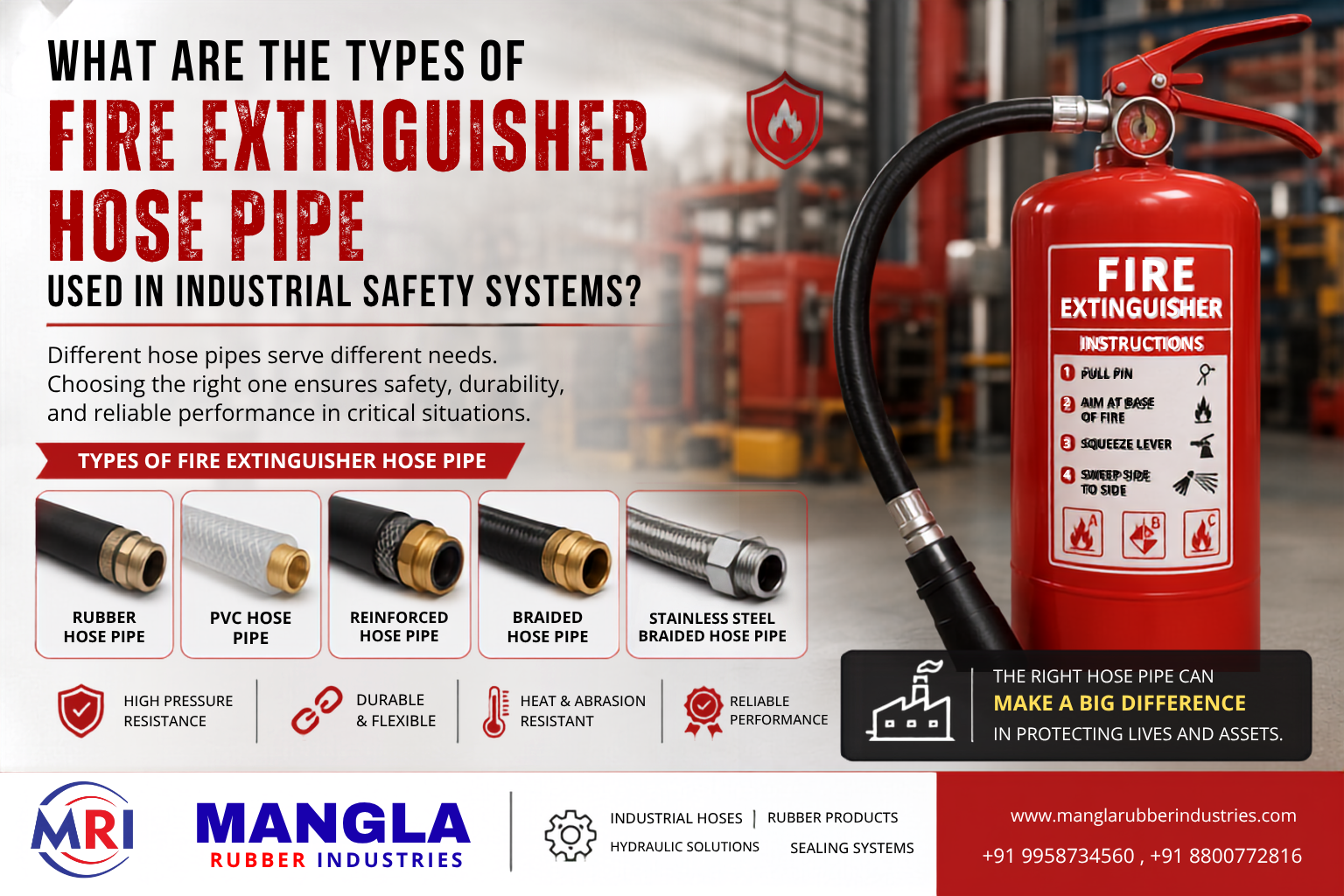
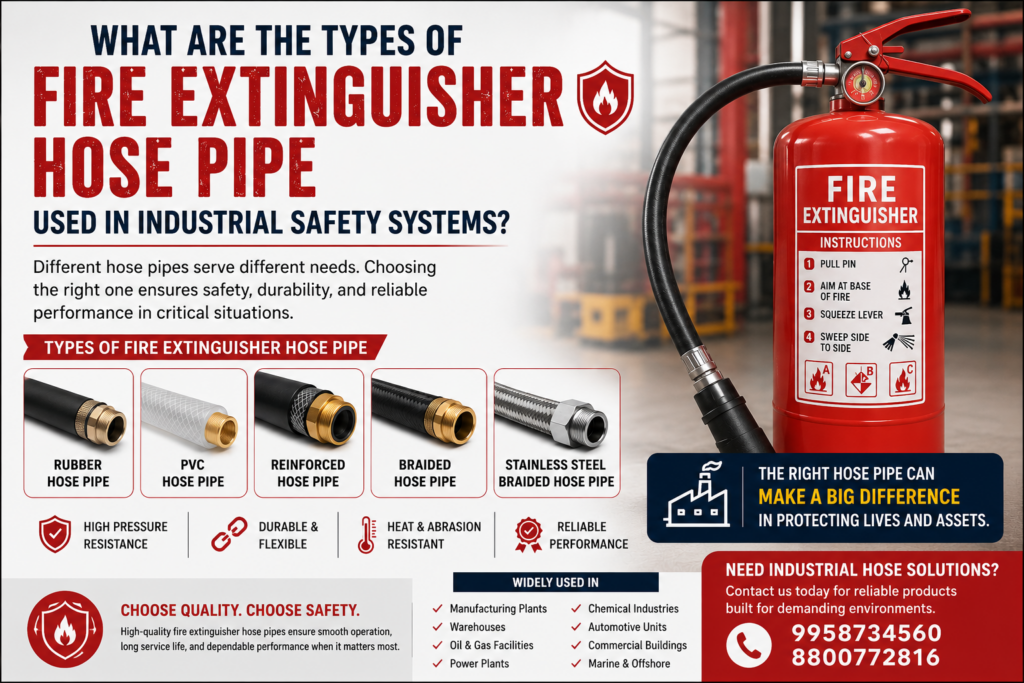
1. Rubber Fire Extinguisher Hose Pipe
Key Features
Flexible and easy to handle
Good resistance to wear and tear
Suitable for medium to high-pressure applications
Long service life with proper maintenance
Common Applications
Manufacturing plants
Warehouses
Automotive facilities
General industrial fire safety systems
These hoses are widely preferred because they balance flexibility, durability, and cost-effectiveness.
2. PVC Fire Extinguisher Hose Pipe
Key Features
Lightweight construction
Easy handling and storage
Corrosion resistant
Economical option for low to moderate duty use
Common Applications
Commercial buildings
Offices
Retail spaces
Light industrial facilities
While PVC hoses are practical for many environments, they may not be ideal for heavy-duty industrial conditions involving extreme temperatures or rough handling.
3. Reinforced Fire Extinguisher Hose Pipe
Key Features
Higher burst strength
Better dimensional stability
Improved resistance to kinking
Suitable for demanding industrial use
Common Applications
Large industrial plants
Oil and gas facilities
Chemical processing units
High-pressure firefighting systems
These hoses are often selected where reliability under pressure is a major requirement.
4. Braided Fire Extinguisher Hose Pipe
Key Features
Excellent flexibility
Enhanced pressure resistance
Reduced risk of hose collapse
Durable construction
Common Applications
Portable fire extinguishers
Industrial firefighting equipment
Marine safety systems
Mobile emergency response units
5. Stainless Steel Braided Hose for Specialized Systems
Key Features
Excellent corrosion resistance
High-temperature capability
Long operational life
Suitable for harsh industrial environments
Common Applications
Chemical plants
Marine applications
Power plants
Specialized suppression systems
Types of Fire Extinguisher Hose Pipe by Extinguishing Agent
Hose selection also depends on the extinguishing medium used.
Extinguisher Type | Typical Hose Requirement |
|---|---|
Water | Rubber or reinforced hose |
Foam | Chemical-resistant rubber hose |
Dry Powder | Flexible reinforced hose |
CO₂ | Specialized discharge horn or hose assembly |
Clean Agent | Compatible high-pressure hose |
How to Choose the Right Fire Extinguisher Hose Pipe
When selecting a hose pipe for industrial safety systems, businesses should evaluate:
Pressure Rating
Ensure the hose can safely handle the extinguisher’s operating pressure.
Temperature Resistance
Industrial facilities may expose hoses to heat, sunlight, or varying weather conditions.
Chemical Compatibility
Chemical plants and process industries require hoses resistant to specific chemicals.
Flexibility
Portable extinguishers benefit from lightweight, flexible hose designs.
Durability
Heavy industrial environments often require reinforced or braided constructions.
Maintenance and Inspection Guidelines
Even high-quality hoses require regular inspection.
Check for:
Cracks or surface damage
Bulging or deformation
Loose fittings
Abrasion marks
Leaks during pressure testing
Signs of aging or hardening
Routine maintenance helps ensure the hose performs reliably during an emergency.
Industrial Applications of Fire Extinguisher Hose Pipes
Fire extinguisher hose pipes are commonly used in:
Manufacturing plants
Warehouses
Power generation facilities
Oil and gas installations
Food processing units
Automotive factories
Commercial buildings
Logistics centers
Each environment may require different hose specifications based on fire risk and operating conditions.
Conclusion
Choosing the right fire extinguisher hose pipe is an important part of building a reliable industrial safety system. Rubber, PVC, reinforced, braided, and stainless steel hose variants each serve different operational needs, pressure requirements, and environmental conditions.
For industrial facilities, the best choice depends on factors such as extinguisher type, working pressure, temperature exposure, and durability requirements. Regular inspection and proper maintenance are equally important to ensure the hose performs effectively when needed most.
Companies seeking dependable industrial hose and rubber solutions can contact Mangla Rubber Industries for product information and application support.
FAQs
What is a fire extinguisher hose pipe used for?
It is used to direct the extinguishing agent from the extinguisher to the fire source safely and accurately.
Which type of fire extinguisher hose pipe is best for industrial use?
Reinforced rubber hoses are commonly preferred for industrial environments because they offer durability and pressure resistance.
Are PVC fire extinguisher hoses suitable for factories?
They can be used in light industrial settings, but heavy-duty factories often require reinforced or rubber hose constructions.
How often should fire extinguisher hoses be inspected?
Inspection frequency depends on safety regulations and site conditions, but regular visual checks and periodic testing are recommended.
Can damaged fire extinguisher hose pipes be repaired?
In many cases, replacement is the safer option, especially if the hose shows cracks, bulging, leaks, or significant wear.