Smart Hose Assemblies
In the modern industrial landscape, safety and efficiency are no longer just goals—they are mandates. For facilities handling hazardous chemicals, high-pressure gases, or cryogenic fluids, the hose assembly is often the most vulnerable point in the transfer process. Standard hoses, while durable, offer no defense against catastrophic failures like coupling ejections or pull-away incidents. This is where smart hose assemblies have revolutionized fluid transfer technology, providing an automated, passive safety net that protects personnel, equipment, and the environment
What are Smart Hose Assemblies?
At its core, smart hose assemblies are engineered safety systems designed to prevent uncontrolled releases of hazardous materials. Unlike traditional hoses, these assemblies feature an internal safety mechanism consisting of integrated valves at each end fitting, connected by a coated internal cable that runs through the bore of the hose.
Under normal operating conditions, this internal cable is under compression, acting like a spring to keep the valves in an open position, allowing for full flow. However, if the hose experience a catastrophic failure—such as a rupture, a coupling ejection, or a vehicle pull-away—the tension on the cable is released. This triggers the valves to snap shut instantly, stopping the flow in both directions without any human intervention.
Key Benefits of Smart Hose Technology
The adoption of smart hose assemblies offers several layers of protection and operational advantages that go far beyond standard compliance.
Passive Activation: One of the primary advantages of smart hose assemblies is that they are passive systems.They do not require an operator to press a “kill switch” or be present at the site of the failure. The shutdown is mechanical and instantaneous.
Environmental Protection: By immediately stopping the flow of chemicals or petroleum during a leak, smart hose assemblies prevent large-scale spills that could lead to devastating environmental damage and astronomical cleanup costs.
Reduced Equipment Damage: During a “pull-away” event (where a truck or railcar moves while still connected), a standard hose can exert up to 15,000 lbs. of force on plant piping before failing. smart hose assemblies with break-away technology disconnect safely, protecting expensive bulkheads and loading arms.
Predictive Maintenance: Modern variations of smart hose assemblies are now integrating IoT sensors. These sensors monitor pressure, temperature, and internal wear, sending real-time data to maintenance teams to replace hoses before a failure even occurs.
Applications Across Industries
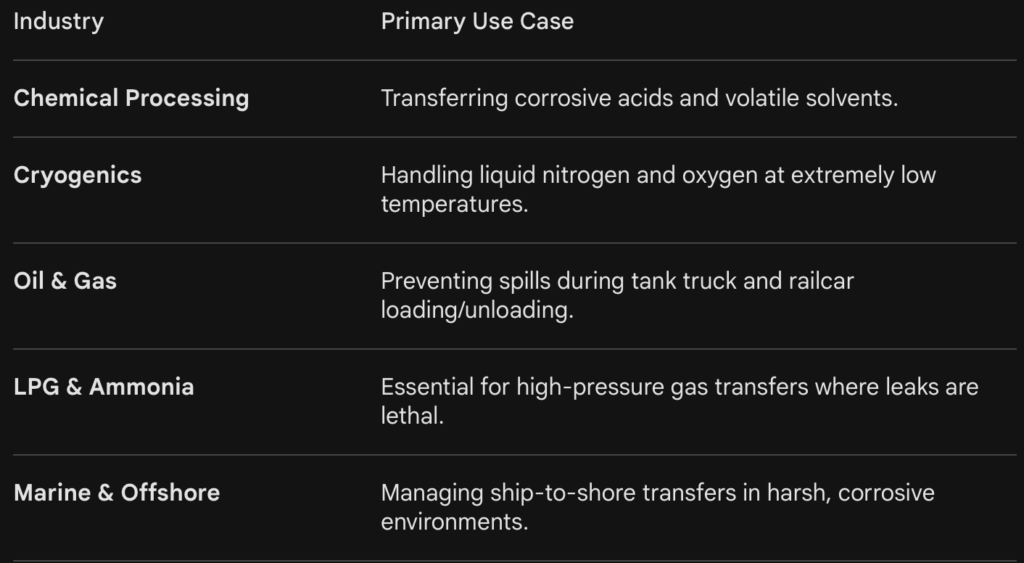
Why the Shift to "Smart" is Essential
The industrial world is moving toward “Zero Harm” policies. In this context, relying on manual safety procedures is no longer sufficient. Smart hose assemblies address the “weak link” in the chain by making the hose itself intelligent enough to respond to danger.
Furthermore, regulatory bodies like the DOT and NFPA have recognized the efficacy of these systems. In many high-pressure gas applications, smart hose assemblies are either recommended or required to meet specific safety exemptions. By investing in this technology, companies not only protect their workforce but also ensure they are ahead of the curve regarding safety legislation.
Conclusion
The evolution of fluid transfer has led us from simple rubber tubes to highly sophisticated smart hose assemblies. By integrating internal valve systems and sensor technology, these assemblies have turned a potential hazard into a fail-safe component of industrial infrastructure. Whether you are looking to reduce the risk of a catastrophic spill or simply want to modernize your maintenance protocols through IoT integration, smart hose assemblies represent the gold standard in fluid transfer safety.
Investing in smart hose assemblies is not just about buying a better hose; it is about buying peace of mind and ensuring that your operations remain productive, safe, and environmentally