Industrial hoses are no longer “dumb” pieces of rubber and steel. In 2026, industrial hoses are becoming smart, sensor-embedded nodes in the industrial IoT—part of a broader shift toward predictive maintenance, real-time safety, and digital-twin-enabled operations. Welcome to the year of the Connected Hose.
From Passive Tube to Smart Asset
Traditionally, an industrial hose was treated as a low-cost, high-wear consumable: install, inspect periodically, replace when it fails. In 2026, that mindset is breaking down.
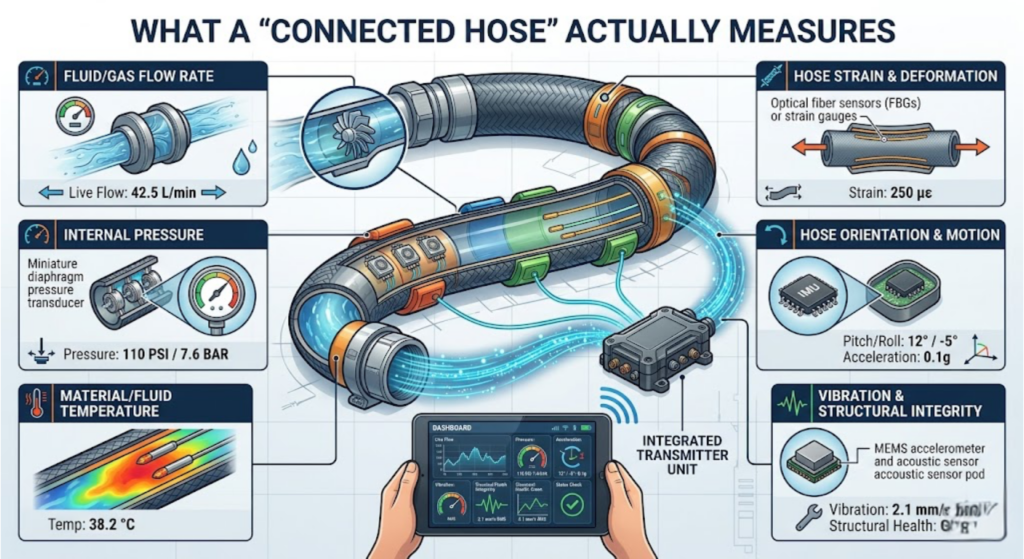
Modern connected industrial hoses embed strain gauges, pressure transducers, temperature sensors, and even accelerometers or RFID tags that track age, location, and usage cycles. These sensors turn a simple industrial hose into a live data-generating asset within the plant’s digital ecosystem.
What a “Connected Hose” Actually Measures
In 2026-style systems, a smart industrial hose can monitor multiple parameters in real time:
Pressure and Flow: Detects spikes, blockages, or unexpected drops that signal leaks in the industrial hose or partial failures.
Temperature at the Wall: Flags overheating from friction, chemical reactions, or proximity to hot equipment.
Strain and Flex: Records bend cycles, kinks, and overstretched sections that accelerate fatigue in industrial hoses.
Vibration and Movement: Flags dragging, snagging, or improper routing that could lead to abrasion or bursts.
Some systems even add chemical-resistance sensors or wear-indicating coatings that signal degradation when the inner tube of the industrial hose is nearing its service-life limit. This data feeds into cloud platforms, enabling condition-based rather than calendar-based replacement schedules for every industrial hose in the facility.
Safety and Predictive Maintenance Payoff
The biggest impact of the connected industrial hose is in safety and uptime. A burst hydraulic line or a leaking chemical industrial hose can shut down an entire production line, damage equipment, or create hazardous exposure. In 2026, operations teams receive alerts when an industrial hose approaches its pressure or cycle limit.
Predictive-maintenance algorithms correlate data from the industrial hose with pump behavior and ambient conditions to flag “at-risk” segments. This reduces unplanned downtime and gives maintenance teams a prioritized roadmap instead of relying solely on visual inspection checklists for each industrial hose.
Integration with Industry 4.0 and Digital Twins
The connected industrial hose is not an isolated gadget; it is a core chapter of the larger Industry 4.0 story. In 2026, plants are increasingly building digital twins of their fluid-transfer systems, where every industrial hose, valve, and pump is mapped virtually and fed live data.
When an industrial hose starts showing abnormal strain, the digital twin can simulate how a rupture at that specific point would affect flow or overall system stability. For asset-intensive industries like oil & gas, mining, and chemical processing, this deep visibility into the industrial hose network is becoming a massive competitive differentiator.
Challenges and Future Outlook
Despite the promise, the smart industrial hose still faces hurdles: the ruggedness of embedded electronics in harsh environments, wireless-communication reliability in metal-heavy plants, and the cost-to-return ratio for lower-pressure industrial hoses.
Nevertheless, 2026 marks the inflection point where these specialized industrial hoses move from experimental pilot projects to mainstream adoption. The next phase will likely see an industrial hose equipped with self-diagnostic AI “edge” processors and tighter integration with enterprise-asset-management (EAM) platforms.
The Big Picture
In 2026, the industrial hose is no longer a forgotten background component. It is a connected, data-rich node that helps operators see inside the “veins” of their plants—anticipating failure and making fluid-transfer systems safer and more efficient than ever before. The era of the “dumb” industrial hose is officially over; the connected era has arrived.