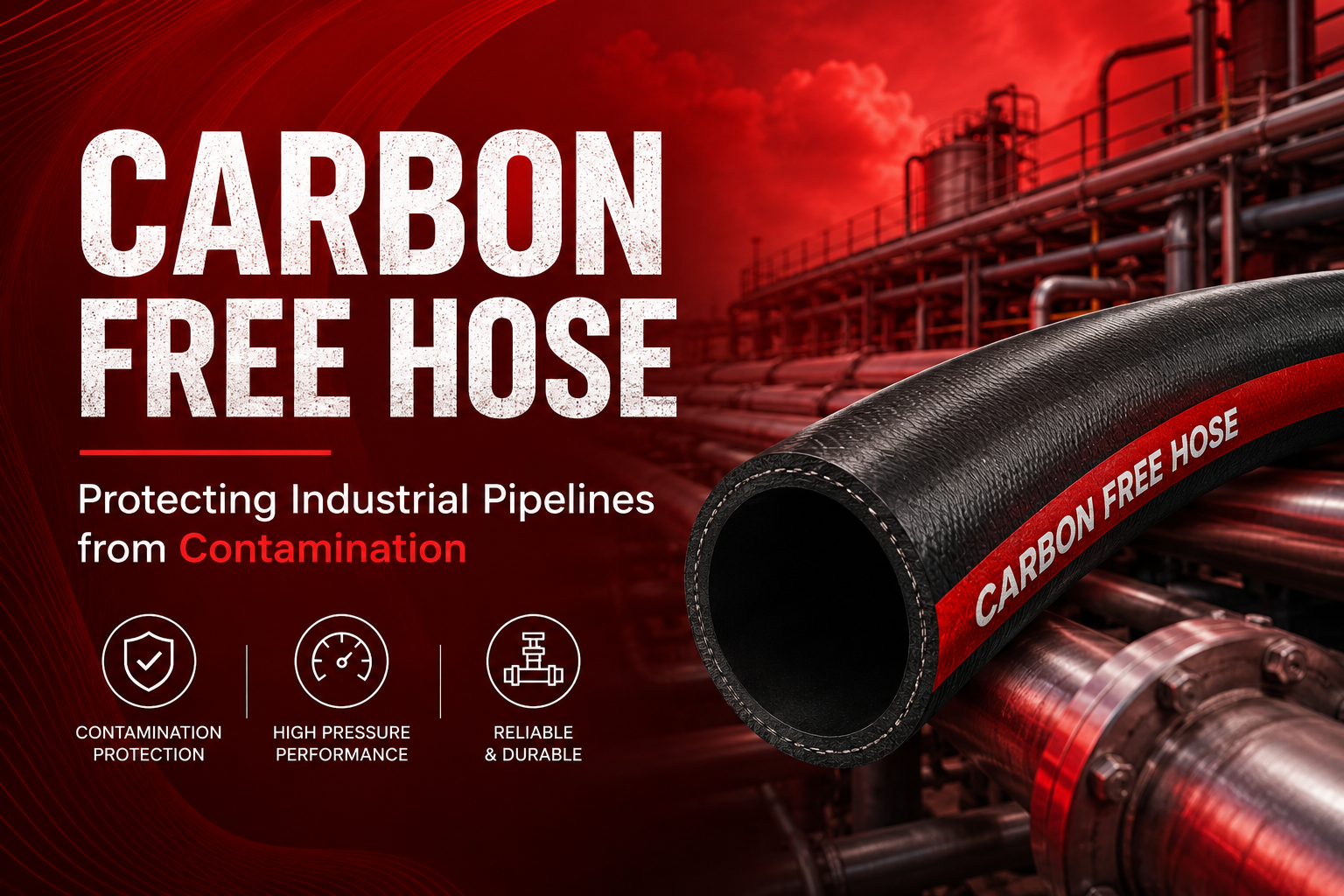
Industrial operations rely heavily on clean and efficient fluid transfer systems. Whether it is the movement of chemicals, solvents, gases, or sensitive industrial compounds, maintaining product purity is a top priority. Even a small amount of contamination can lead to product rejection, equipment damage, safety concerns, and significant financial losses.
This is where the Carbon Free Hose and chemical hose play a crucial role. These specialized hoses are designed to transport sensitive materials without affecting their composition, quality, or performance. Industries such as pharmaceuticals, food processing, electronics, chemical manufacturing, and steel production depend on these hose systems to maintain operational integrity and meet stringent quality standards.
As industrial processes become more advanced, the demand for contamination-free transfer solutions continues to grow. Understanding how a Carbon Free Hose works and why it is important can help businesses choose the right equipment for their applications.
Understanding the Role of Carbon Free Hose in Industrial Applications
Industrial operations rely heavily on clean and efficient fluid transfer systems. Whether it is the movement of chemicals, solvents, gases, or sensitive industrial compounds, maintaining product purity is a top priority. Even a small amount of contamination can lead to product rejection, equipment damage, safety concerns, and significant financial losses.
This is where the Carbon Free Hose and chemical hose play a crucial role. These specialized hoses are designed to transport sensitive materials without affecting their composition, quality, or performance. Industries such as pharmaceuticals, food processing, electronics, chemical manufacturing, and steel production depend on these hose systems to maintain operational integrity and meet stringent quality standards.
As industrial processes become more advanced, the demand for contamination-free transfer solutions continues to grow. Understanding how a Carbon Free Hose works and why it is important can help businesses choose the right equipment for their applications.
Why Is Pipeline Contamination a Serious Industrial Concern?
Many industries spend significant resources ensuring that their products remain pure from production to packaging. But what happens if contamination enters the system through a hose?
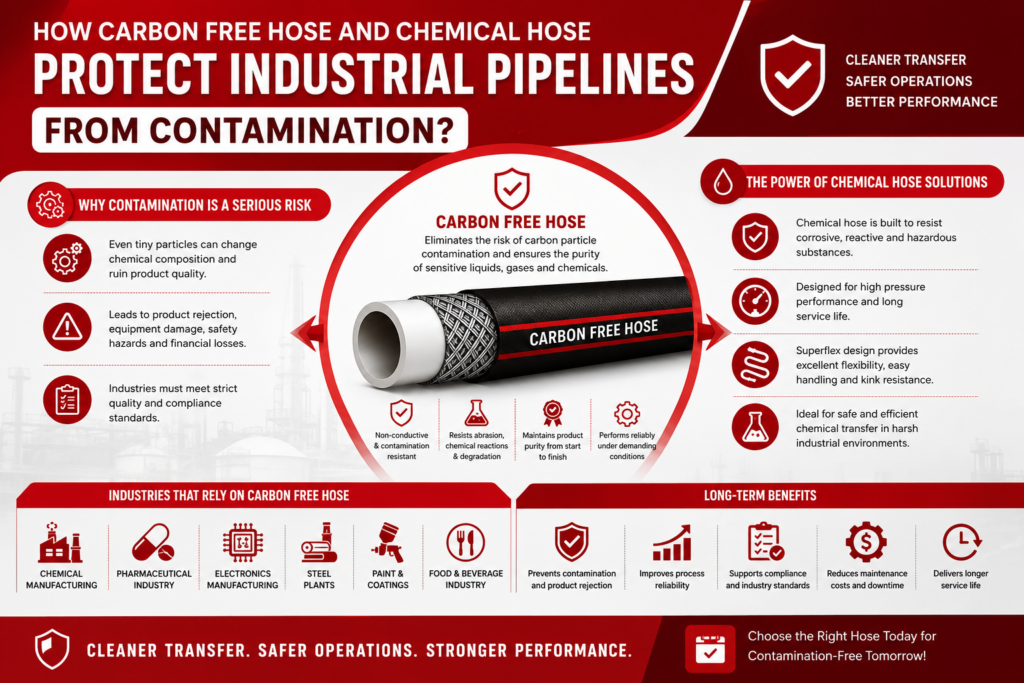
Even microscopic particles can alter chemical compositions, affect product performance, and lead to compliance failures. In sectors such as pharmaceuticals and electronics manufacturing, contamination can result in entire production batches being discarded.
This is why selecting a high-quality Carbon Free Hose is not simply a maintenance decision. It is a quality control measure that directly impacts production efficiency and customer satisfaction.
How Does a Carbon Free Hose Prevent Contamination?
The contamination prevention capabilities of a Carbon Free Hose come from its specialized construction. Unlike conventional hoses, it does not release carbon particles during operation.
The hose lining is designed to resist abrasion, chemical reactions, and material degradation. This ensures that transported substances remain free from unwanted impurities.
In many industrial environments, hoses are subjected to continuous movement, pressure fluctuations, and exposure to harsh substances. A properly engineered Carbon Free Hose maintains its integrity under demanding conditions, preventing contamination while delivering reliable performance.
Can the Wrong Hose Affect Product Quality?
The answer is yes.
Using a standard hose in contamination-sensitive applications can introduce unwanted particles into the system. Over time, hose degradation, internal wear, and chemical incompatibility may cause contamination that is not immediately visible.
A dedicated Carbon Free Hose eliminates this risk by providing a clean transfer pathway. Industries that prioritize quality assurance often specify carbon-free solutions as part of their standard operating procedures.
When transferring valuable chemicals or high-purity compounds, the choice of hose can be just as important as the processing equipment itself.
The Importance of Chemical Hose in Industrial Fluid Transfer
While contamination control is essential, chemical resistance is equally important. A high-performance chemical hose is designed to safely transfer aggressive chemicals without degradation or leakage.
Industrial chemicals can be highly corrosive, reactive, or hazardous. Standard hoses may crack, swell, or weaken when exposed to these substances, creating safety risks and increasing maintenance costs.
A quality chemical hose pipe is engineered with materials that resist a wide range of chemical compounds. This helps maintain flow efficiency while protecting workers, equipment, and the environment.
Many industries combine a Carbon Free Hose with a chemical hose solution to achieve both contamination prevention and chemical compatibility.
Selecting the right hose is not limited to chemical applications. Many industries also require reliable solutions for compressed air, water distribution, and petroleum transfer. Understanding the differences between various industrial hoses can help businesses improve safety, efficiency, and equipment life.
If you want to explore how industrial hoses perform across multiple applications, including air, water, and petroleum transfer, read our detailed guide here: Air, Water and Petroleum Hose Guide. The article explains key hose characteristics, application areas, and factors to consider when choosing the right hose for industrial operations.
High Pressure Performance in Demanding Environments
Industrial fluid transfer systems often operate under high pressure conditions. Whether transferring chemicals across production facilities or loading materials into storage tanks, hoses must withstand intense operating demands.
A premium Carbon Free Hose is designed to perform reliably under high pressure applications. Reinforced construction helps maintain structural stability while reducing the risk of bursting or deformation.
Similarly, advanced chemical hose pipe systems are built to handle varying pressure levels without compromising safety or transfer efficiency.
The combination of contamination resistance and high pressure capability makes these hoses suitable for some of the most demanding industrial processes.
Superflex Chemical Hose for Enhanced Flexibility
Modern facilities require hoses that are not only durable but also easy to handle. This is where the superflex chemical hose offers significant advantages.
A superflex chemical hose provides excellent flexibility while maintaining chemical resistance and structural strength. Operators can maneuver the hose more easily in confined spaces, reducing strain during installation and operation.
The flexible design also minimizes kinking, which helps maintain smooth flow rates and reduces wear over time.
When paired with a Carbon Free Hose solution, a superflex chemical hose can improve both operational efficiency and contamination control.
Chemical Transfer Hose and Safe Material Handling
The safe movement of industrial chemicals depends heavily on the reliability of the hose system. A specialized chemical transfer hose is designed to transport chemicals safely from one point to another while minimizing risks.
A quality chemical transfer hose can handle a variety of substances, including acids, solvents, petroleum products, and specialty chemicals. Its construction helps prevent leaks, chemical attacks, and premature failure.
Industries that handle hazardous materials often invest in premium chemical transfer hose systems because downtime caused by hose failure can be extremely costly.
By integrating a Carbon Free Hose into critical transfer applications, companies can further enhance contamination protection while maintaining safe operations.
Industries That Benefit from Carbon Free Hose Solutions
The applications of a Carbon Free Hose extend across numerous industries.
Chemical manufacturing facilities use these hoses to prevent contamination during production and transportation processes. Pharmaceutical companies depend on contamination-free transfer systems to maintain product purity. Steel plants utilize carbon-free solutions for oxygen transfer applications where cleanliness is critical.
Electronics manufacturers often require contamination-resistant equipment because even small impurities can affect product performance. Paint and coating industries also rely on Carbon Free Hose systems to preserve color consistency and product quality.
In each of these sectors, contamination prevention contributes directly to operational success.
Long-Term Benefits of Using Carbon Free Hose
Investing in a high-quality Carbon Free Hose delivers several long-term advantages.
First, it helps reduce product rejection caused by contamination. Second, it improves process reliability by minimizing hose-related failures. Third, it supports compliance with industry standards and quality requirements.
When combined with a durable chemical hose, businesses can achieve safer fluid transfer, lower maintenance costs, and longer service life.
The result is a more efficient operation that protects both product quality and profitability.
Industrial hose selection should always be based on operating pressure, fluid compatibility, environmental conditions, and long-term performance requirements. While a Carbon Free Hose is essential for contamination-sensitive applications, other industrial processes may require specialized solutions for air, water, or petroleum handling.
To gain a broader understanding of industrial hose applications and selection criteria, visit our comprehensive article on Air, Water, and Petroleum Hoses. It provides valuable insights into hose construction, performance expectations, and industry-specific usage requirements that can help businesses make informed purchasing decisions. Explore the article here: Air, Water and Petroleum Hose Guide. This resource complements the information discussed in this blog and offers practical guidance for various industrial environments.
The website of Mangla Rubber Industries highlights that the company manufactures industrial hose solutions including hydraulic, chemical, water, steam, PTFE, and carbon-free hose products for modern industrial applications.
Conclusion
Industrial contamination can have serious consequences for product quality, operational efficiency, and workplace safety. Choosing the right hose solution is one of the most effective ways to prevent these issues before they occur.
A Carbon Free Hose provides a clean and reliable transfer pathway that minimizes the risk of carbon particle contamination. At the same time, a high-performance chemical hose, chemical hose pipe, superflex chemical hose, and chemical transfer hose ensure safe handling of aggressive chemicals under demanding conditions.
For industries where purity, safety, and performance are non-negotiable, investing in the right hose technology is a critical step toward maintaining consistent and contamination-free operations.
Stay updated with the latest innovations in industrial hose technology, material handling solutions, and industry insights by following us on LinkedIn. At Mangla Rubber Industries, we regularly share product updates, application knowledge, and practical solutions that help businesses improve operational efficiency and safety. Connect with us here: Mangla Rubber Industries LinkedIn Page
FAQs
A Carbon Free Hose is used in applications where contamination must be avoided. It is commonly used for oxygen transfer, specialty chemicals, pharmaceuticals, and other sensitive industrial processes.
A Carbon Free Hose is manufactured using materials that do not release carbon particles, helping maintain the purity of the transferred product.
A chemical hose is specifically designed to resist chemical attack, corrosion, and degradation, making it suitable for handling aggressive industrial chemicals.
Yes, many Carbon Free Hose products are engineered for high pressure environments and provide reliable performance under demanding operating conditions.
A chemical transfer hose ensures safe and efficient movement of chemicals while minimizing the risks of leakage, contamination, and equipment damage.