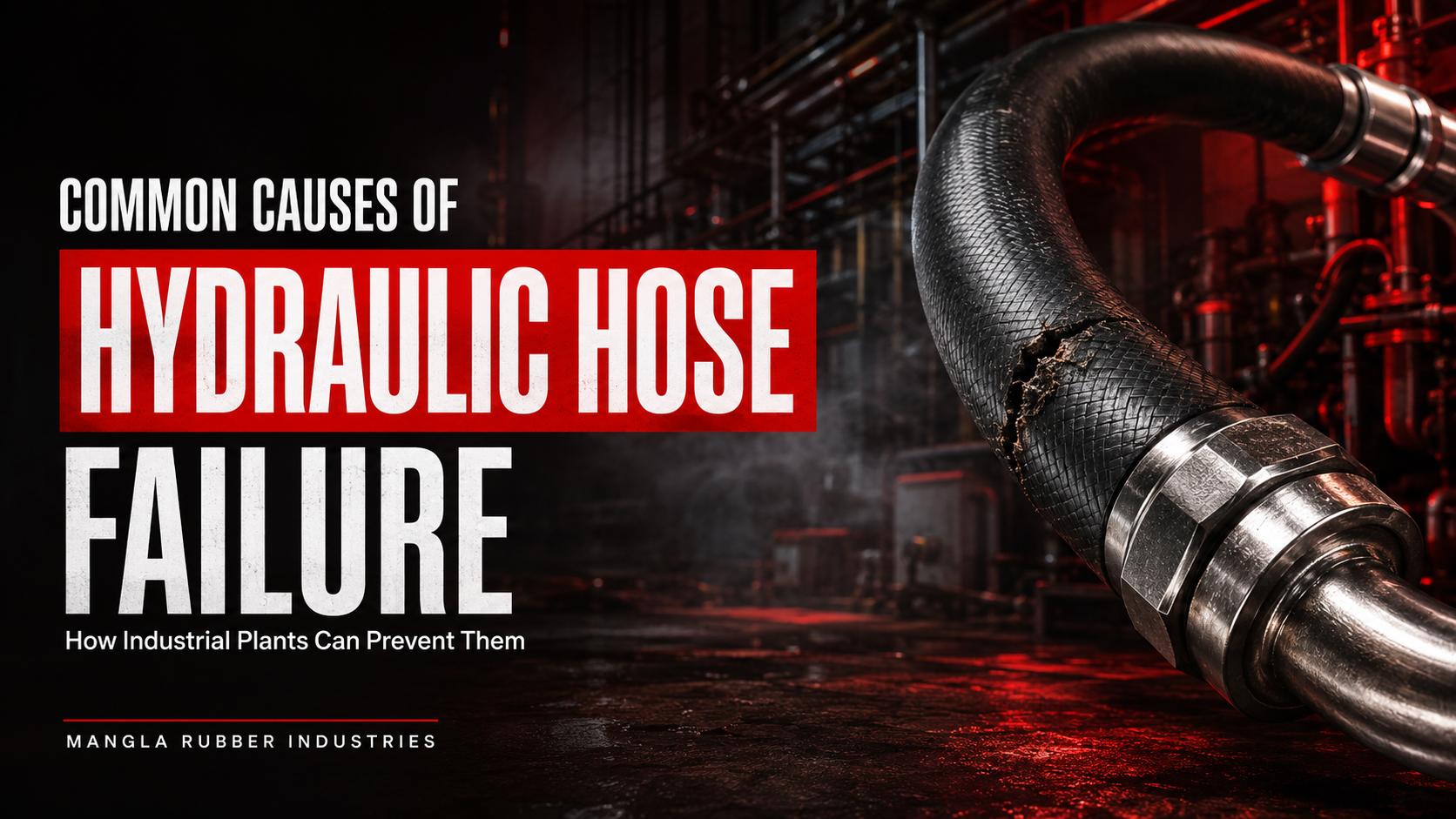
A Hydraulic Hose carries pressurised fluid while facing heat, vibration, movement, and contact with surrounding equipment. Wear can develop inside the tube, reinforcement, or fitting before it becomes visible.
When a Hydraulic Hose leaks or bursts, production can stop, fluid may contaminate the area, and connected components can suffer damage. Plants reduce repeat failures by correcting the operating cause, not simply changing the part.
Plant teams can follow Mangla Rubber Industries on LinkedIn for updates on industrial hoses, fluid-transfer applications, and maintenance.
Why Hydraulic Hose Failure Affects the Complete System
A hose is a flexible pressure vessel. Its tube must suit the fluid, its reinforcement must contain pressure, and its cover must resist the working environment.
A failing Hydraulic Hose may cause slow actuators, unstable response, oil loss, or sudden pressure release. An unexplained hydraulic hose pressure drop can reduce available force. Each Hydraulic Hose should therefore be treated as part of the circuit, not an isolated consumable.
What Causes Hydraulic Hose Failure in Industrial Plants?
The visible break does not always reveal the original cause. A useful investigation considers pressure, temperature, fluid, assembly quality, movement, and the surrounding area together.
What the Failure Location Reveals About Hydraulic Hose Damage
The point where a Hydraulic Hose fails provides useful evidence. Leakage close to a coupling can indicate excessive bending, incorrect insertion, poor crimping, or movement concentrated at the end. Damage along an outer curve may show that the line exceeded its minimum bend radius.
A rupture in the middle of a Hydraulic Hose may indicate abrasion, impact, local heat, or excessive pressure. A hard, cracked cover suggests heat or ageing, while a swollen tube may indicate fluid incompatibility. Corroded reinforcement usually shows that cover damage existed before the final failure.
Technicians should retain the damaged Hydraulic Hose while documenting its condition. Photograph the failed area, fittings, routing, clamps, and nearby parts. Review pressure records, fluid condition, installation history, and recent machine changes. This evidence prevents conclusions based only on the final break.
Pressure Spikes and Incorrect Selection
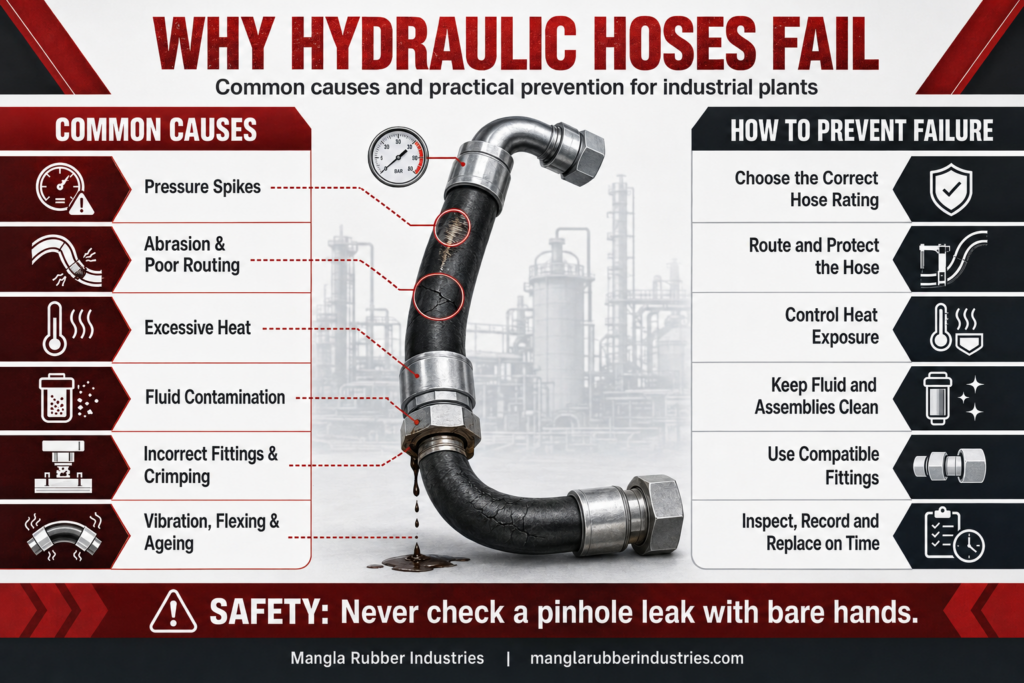
Every Hydraulic Hose has a working-pressure limit. Abrupt valve closure, blocked flow, relief-valve faults, or rapid cylinder movement can create peaks above normal readings. Repeated peaks weaken the reinforcement and are common hydraulic hose burst causes.
A replacement chosen only by diameter or fitting size may have the wrong pressure, temperature, impulse, or fluid rating. An undersized bore can increase heat and flow restriction. Buyers can review the high-pressure hose selection guide and SAE 100 R1 and R2 pressure comparison before finalising a specification.
Abrasion and Poor Routing
Most hydraulic hose abrasion failure begins with repeated contact against a frame, guard, sharp edge, or neighbouring line. Once the cover wears away, the reinforcement becomes vulnerable to damage and corrosion. A Hydraulic Hose can then lose pressure capacity quickly.
Routing should allow movement without letting the line strike nearby parts. Clamps, abrasion sleeves, and angled adapters help maintain clearance. The minimum bend radius is especially important near couplings, where bending concentrates stress.
Excessive Heat, Contamination, and Fluid Incompatibility
Heat accelerates rubber ageing. The cover may crack while the tube loses flexibility. A Hydraulic Hose near an exhaust, furnace, or hot manifold may require shielding or a suitable high-temperature compound.
Mineral oil, water-glycol, synthetic media, and biodegradable fluids do not suit every tube material. An incompatible compound may swell, harden, or separate. Dirt, water, and degraded oil add internal wear, making filtration, fluid analysis, and clean assembly essential.
Incorrect Fittings, Crimping, and Installation
Incomplete stem insertion, an incorrect crimp, mismatched components, or damaged sealing surfaces can cause leakage or fitting separation. A Hydraulic Hose may also twist when a connection is tightened without supporting the opposite end.
A hose is designed to bend, not work under torsion. A spiralling lay line indicates twist. Correct adapters and fitting orientation should let the line move without stretching, kinking, or pulling at the coupling.
Repeated Flexing, Vibration, and Ageing
Pressure pulsation, vibration, and movement strain bends and couplings. Over time, they can cause hydraulic hose fatigue cracking even below the stated maximum pressure.
Risk rises when a Hydraulic Hose bends behind a fitting, moves in several planes, or exceeds its bend limit. Better support and longer sweep bends distribute movement across a larger section.
How Can Plants Prevent Hydraulic Hose Failure?
Maintain a register covering equipment location, bore, pressure, fluid, temperature, connections, installation date, and replacement history. It exposes recurring faults and prevents unsuitable spares from being fitted because their ends appear to match.
Inspect every Hydraulic Hose for wetness, cuts, hardening, blisters, exposed wire, loose clamps, and fitting damage. Follow the plant’s isolation and depressurisation procedure. Never use a bare hand to locate a pinhole leak because pressurised fluid can penetrate skin.
Use the guide to warning signs of Hydraulic Hose failure and the article on maintaining Hydraulic Hose assemblies to support inspection planning.
Inspection frequency should reflect machine duty rather than one plant-wide interval. Critical assemblies may need checks each shift, while less demanding services can be reviewed during planned maintenance. Shorten the interval when a location has a history of abrasion, leakage, or repeated replacement.
Maintenance records add context. Note where the defect appeared, how long the assembly was in service, and what the machine was doing when the problem developed. If several replacements show similar damage, engineering teams can review routing, protection, component selection, or system settings instead of accepting the failure as normal wear.
Measure pressure under realistic load, not only at idle. Check relief and control components when surges appear. Examine removed assemblies before disposal because the damage pattern can reveal the underlying cause.
Planning Replacement Around Plant Risk
A fixed replacement calendar does not suit every application. Duty cycles, pressure impulses, temperature, movement, exposure, and failure consequences vary. A Hydraulic Hose on a continuously operating press may need closer attention than the same assembly on auxiliary equipment.
For each Hydraulic Hose, combine inspection findings with service history and equipment criticality. Lines where leakage could reach hot surfaces, contaminate products, or stop production deserve shorter intervals. Planned shutdown replacement is easier to control than emergency work after rupture.
This makes Hydraulic Hose replacement a risk-based decision instead of a reaction to leakage. It gives buyers time to confirm specifications, maintain stock, and avoid fitting an unsuitable assembly under production pressure.
Improving Hydraulic Hose Leakage Prevention
Effective leak prevention depends on the complete assembly. The tube, reinforcement, cover, fittings, seals, and installation method must suit one application. Mixed or unverified components may not retain their rated pressure.
For slow cylinders or weak tools, inspect the Hydraulic Hose, pump, valves, filters, and fluid. A crushed line, sharp bend, restricted fitting, or separated tube can reduce flow. Correct the sizing or routing before replacement.
When Replacement Is Safer Than Repair
A leaking, blistered, kinked, or reinforcement-exposed Hydraulic Hose should be removed. A patch cannot restore damaged reinforcement, and a temporary clamp is not a suitable pressure-line repair. Check the replacement and its compatible fittings after installation.
Explore the product range on the Mangla Rubber Industries For a Hydraulic Hose requirement involving custom lengths, fittings, or bulk quantities, contact Mangla Rubber Industries with the fluid, pressure, temperature, bore, connections, and application details.
When ordering a Hydraulic Hose, provide operating data rather than relying only on the removed part. Changes in fluid, pressure, cycle speed, temperature, routing, or equipment function may require a different specification. Accurate information helps prevent another selection error.
Conclusion
Building a More Reliable Maintenance Culture
Most Hydraulic Hose failures combine pressure stress, abrasion, heat, contamination, poor assembly, and repeated flexing. Correct selection, clean installation, pressure monitoring, inspection, and timely replacement reduce these risks.
When operators report changes and technicians record failure patterns, buyers can source the correct Hydraulic Hose. Connecting maintenance findings with purchasing decisions supports safer operation and fewer interruptions across demanding industrial operations.
This discipline also helps planners control spare inventory, schedule shutdown work, and avoid emergency purchasing during critical production periods.
FAQs
1. What is the most common cause of Hydraulic Hose failure?
Abrasion, routing faults, pressure spikes, heat, contamination, and assembly errors are common. Correct the operating cause before installing the replacement.
2.How often should a Hydraulic Hose be inspected?
The interval depends on duty, pressure cycles, environment, and history. Critical machinery may need checks before each shift and during planned maintenance.
3.Can a leaking Hydraulic Hose be repaired?
Replace a damaged pressure-carrying hose as a correctly specified assembly. A patch or clamp does not restore reinforcement strength.
4.Why does a newly installed Hydraulic Hose fail early?
Early failure can indicate the wrong rating, incompatible components, poor crimping, twist, contamination, or pressure surges. Examine the failed assembly and routing first.
5.How can a plant stop failure from returning at the same location?
Observe the line under load and through full movement. Check pressure peaks, bend radius, heat, abrasion, clamps, fittings, length, and bore. Change the routing or specification where needed.