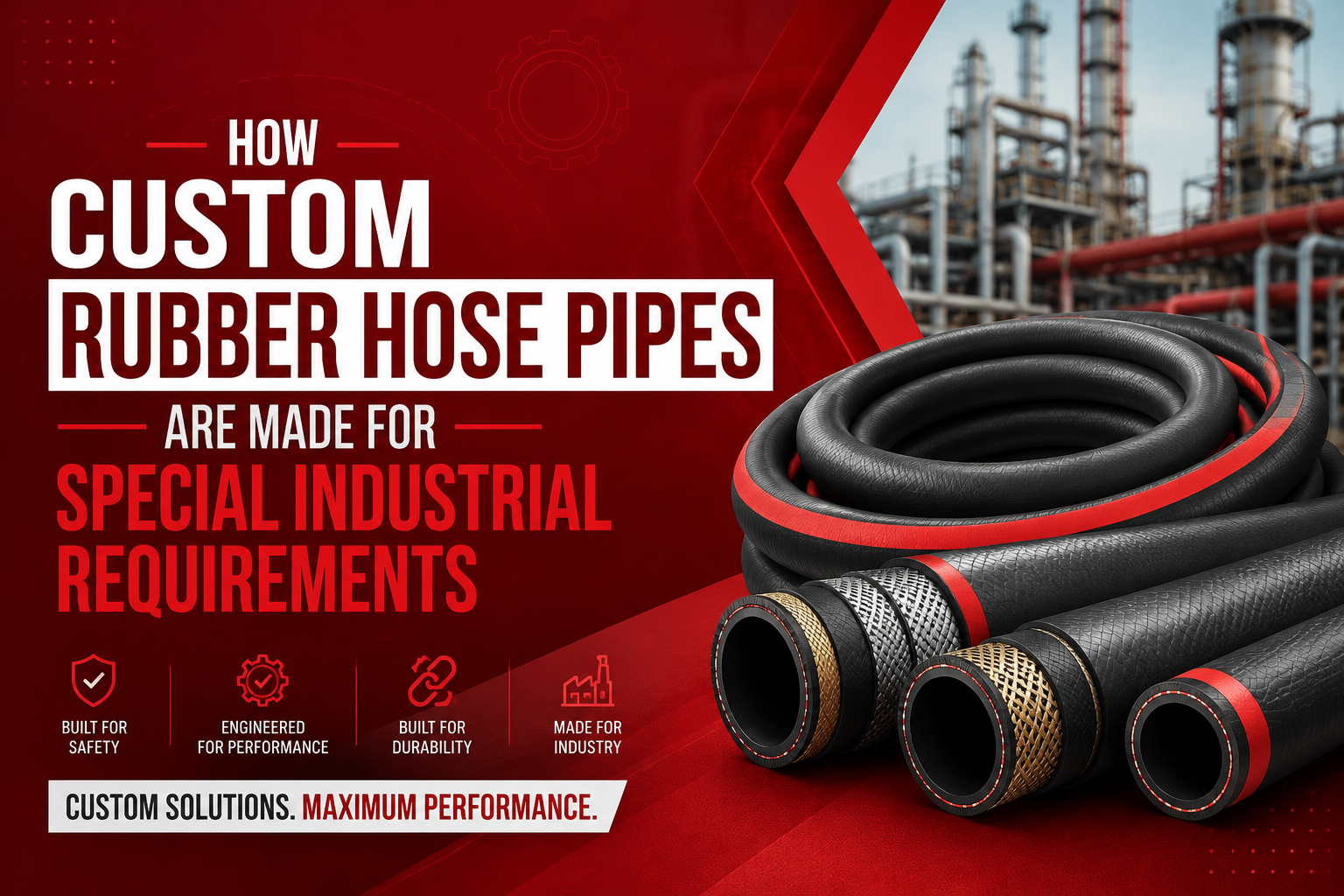
Every industry has unique operational challenges. A hose used in a chemical processing plant cannot be expected to perform the same way as one used in agriculture, construction, mining, or heavy manufacturing. This is why custom Rubber Hose Pipes have become an essential part of modern industrial operations across India.
From handling corrosive chemicals to transferring water under pressure and transporting abrasive materials, industries require hose solutions that are specifically engineered for their applications. Standard products often fail to deliver the required performance, safety, and durability. Custom manufacturing bridges this gap by creating hoses that meet exact operating conditions.
India has emerged as a major hub for industrial hose production, with many rubber hose pipe manufacturers in indiaoffering tailored solutions for diverse sectors. The manufacturing process combines advanced engineering, specialized rubber compounds, reinforcement technologies, and strict quality testing to ensure reliable performance.
But how exactly are custom Rubber Hose Pipes manufactured for specific industrial requirements?
And what factors determine the design and construction of a hose for a particular application?
Let’s understand the complete process.
At Mangla Rubber Industries, we understand that every industry has unique fluid transfer challenges. Whether you need a flexible rubber hose pipe, a heavy-duty industrial rubber hose pipe, or a specialized solution for demanding applications, our experts can help you choose the right product. Get in touch with us today and discover a hose solution built around your exact requirements.
Understanding the Need for Custom Rubber Hose Pipes
Industrial applications vary significantly in terms of pressure, temperature, chemical exposure, flexibility requirements, and environmental conditions. A standard hose may not be able to withstand all these factors simultaneously.
Custom Rubber Hose Pipes are designed after evaluating the exact needs of the application. Manufacturers study the type of fluid being transferred, operating pressure, working temperature, installation environment, and expected service life before developing a solution.
For example, a rubber hose pipes for water used in construction may require high flexibility and abrasion resistance, while a chemical transfer hose needs superior resistance against aggressive substances.
This customization ensures better performance, reduced maintenance, improved safety, and longer operational life.
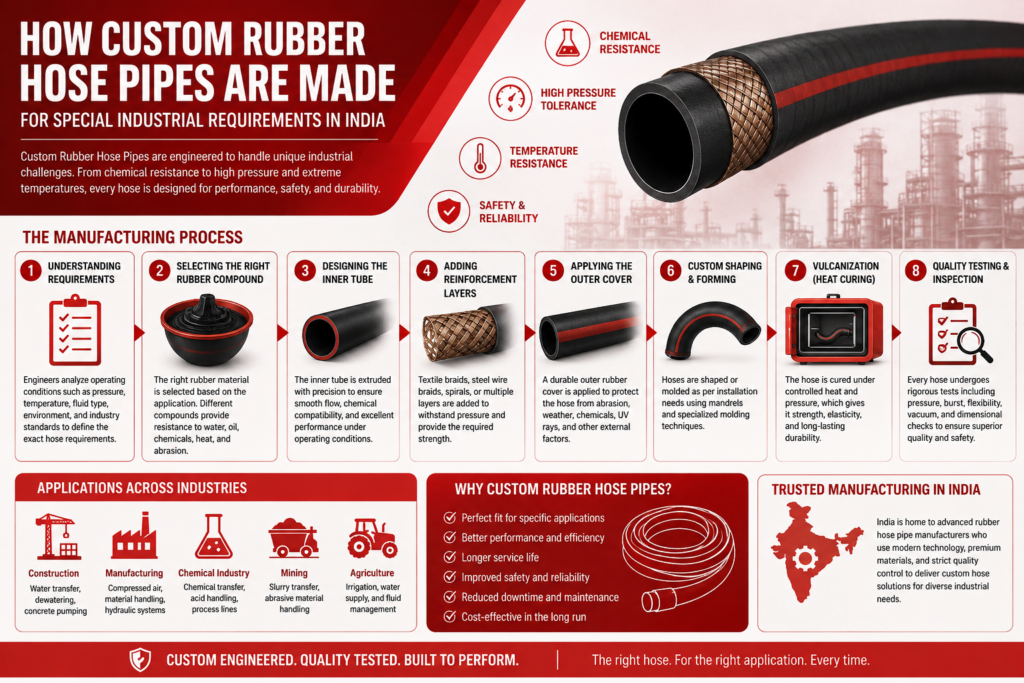
The First Step: Understanding Industrial Requirements
The manufacturing journey starts with gathering technical specifications.
Engineers assess several factors including:
Working pressure requirements
Fluid compatibility
Temperature range
Vacuum resistance
Flexibility requirements
Bending radius
Environmental exposure
Industry regulations
These parameters help determine the ideal rubber compound, reinforcement layer, and hose construction.
Leading rubber hose pipe manufacturers in india work closely with customers to create solutions that perfectly match operational demands.
Selecting the Right Rubber Compound
The quality of any industrial rubber hose pipes begins with the selection of raw materials.
Different applications require different rubber compounds. Manufacturers typically use natural rubber, EPDM, Nitrile, Neoprene, SBR, or other specialized synthetic rubbers depending on the application. The chosen compound directly impacts flexibility, chemical resistance, temperature tolerance, and durability.
For example:
A rubber hose pipe for water often uses compounds that provide excellent weather and water resistance.
Chemical transfer hoses use specialized formulations designed to withstand aggressive chemicals.
Oil handling hoses require compounds resistant to petroleum products.
Each rubber formulation is carefully mixed with additives, curing agents, carbon black, and performance enhancers to achieve the desired characteristics.
Designing the Inner Tube
The inner tube is the layer that comes into direct contact with the transported material.
This component plays a critical role in determining the hose’s compatibility with fluids, gases, chemicals, steam, or water. Any compromise in this layer can lead to contamination, leakage, or premature failure.
For custom Rubber Hose Pipes, the inner tube is designed specifically to handle the intended media while maintaining flexibility and performance.
The extrusion process is used to create this inner layer with precise dimensions and uniform thickness.
Designing the Inner Tube
Once the inner tube is formed, reinforcement layers are added.
This stage determines the strength and pressure handling capability of the hose.
Depending on industrial requirements, manufacturers may use:
Textile braiding
Synthetic yarn reinforcement
Steel wire braiding
Steel wire spirals
Multiple reinforcement layers
The reinforcement structure is selected based on the pressure and operating conditions of the application. High-pressure industrial systems require stronger reinforcement compared to standard water transfer applications.
This is one of the most important stages in the production of custom Rubber Hose Pipes.
Applying the Outer Cover
The outer cover protects the hose from external damage.
Industrial environments often expose hoses to abrasion, sunlight, oil, chemicals, moisture, and mechanical stress.
Manufacturers apply a specially designed outer rubber layer that acts as a protective shield. Many industries prefer a black rubber hose pipe because it offers excellent resistance against weathering, UV exposure, and harsh industrial conditions.
The outer cover is engineered according to the application environment, ensuring maximum durability and service life.
Custom Shaping and Forming
Not every industrial setup can accommodate a straight hose.
Many machines require curved, molded, or specially shaped hoses to fit into compact spaces. In such cases, manufacturers use mandrels and specialized molding techniques to achieve the desired shape. Custom molded hoses are commonly used in automotive systems, heavy machinery, industrial equipment, and process plants.
This stage ensures that the finished Rubber Hose Pipes fit perfectly within the intended installation space.
Vulcanization: The Process That Creates Strength
After assembly, the hose undergoes vulcanization.
This process transforms soft rubber into a durable and elastic material by creating strong molecular bonds within the rubber structure. Heat and pressure are applied under controlled conditions to improve strength, flexibility, heat resistance, and durability.
Without proper vulcanization, even the best-designed Rubber Hose Pipes would fail under industrial stress.
This stage is critical because it directly affects the performance and lifespan of the hose.
Quality Testing and Inspection
Custom industrial hoses cannot leave the factory without rigorous testing.
Manufacturers perform several quality checks including:
Pressure testing
Burst testing
Flexibility testing
Vacuum testing
Dimensional inspection
Chemical resistance evaluation
Leak detection
Performance validation
Many leading rubber hose pipe manufacturers in india maintain in-house testing facilities to ensure every hose meets industry standards before dispatch.
The goal is to ensure that every hose performs safely and consistently under real-world conditions.
Applications of Custom Rubber Hose Pipes
Custom Rubber Hose Pipes are used across a wide range of industries in India.
Construction companies use them for water transfer and dewatering operations.
Manufacturing facilities depend on them for compressed air systems and material handling.
Chemical plants require specially designed hoses for aggressive fluid transfer.
Mining operations use heavy-duty hoses for slurry and abrasive material transportation.
Agricultural businesses rely on flexible rubber hose pipe solutions for irrigation and water management.
Every application demands unique specifications, making customization a necessity rather than a luxury.
At Mangla Rubber Industries, we understand that every industry has unique fluid transfer challenges. Whether you need a flexible rubber hose pipe, a heavy-duty industrial rubber hose pipe, or a specialized solution for demanding applications, our experts can help you choose the right product. Get in touch with us today and discover a hose solution built around your exact requirements.
Why Industries Prefer Custom Solutions
Custom Rubber Hose Pipes provide several advantages over standard products.
They offer better operational efficiency, longer service life, reduced downtime, improved safety, and lower maintenance costs.
A properly designed industrial rubber hose pipe can significantly enhance productivity while minimizing unexpected failures.
This is why industries increasingly partner with experienced rubber hose pipe manufacturers in india that understand application-specific requirements.
If your operation also deals with aggressive chemicals and demanding transfer applications, you may find our detailed guide on hydraulic hose solutions useful. Read more here: Hydraulic Hose Pipe
For more insights into industrial hose safety, performance standards, and maintenance practices, explore our previous blog and discover how the right hose selection can improve workplace safety and operational reliability.
Conclusion
The manufacturing of custom Rubber Hose Pipes is a highly specialized process that combines engineering expertise, advanced materials, and strict quality control.
From selecting the right rubber compound to reinforcement, molding, vulcanization, and testing, every stage is designed to meet specific industrial requirements.
As industries continue to demand greater efficiency and reliability, custom Rubber Hose Pipes will remain an essential component of modern industrial infrastructure. Choosing the right manufacturing partner ensures that your hose solution is built not only for today’s challenges but also for long-term operational success.
Stay updated with the latest innovations in industrial hose technology, manufacturing insights, and industry best practices. Follow Mangla Rubber Industries on LinkedIn for expert knowledge, product updates, and practical solutions that help industries operate more efficiently.
Conclusion
Custom Rubber Hose Pipes are specially designed hoses manufactured according to specific industrial requirements such as pressure, temperature, fluid compatibility, and operating conditions.
Custom solutions provide better performance, improved safety, longer service life, and reduced maintenance compared to standard hose products.
Industries including construction, agriculture, mining, manufacturing, chemical processing, and transportation commonly use flexible rubber hose pipe solutions.
A black rubber hose pipe offers excellent resistance to weather, UV exposure, abrasion, and harsh environmental conditions.
Leading rubber hose pipe manufacturers in india conduct extensive testing such as pressure testing, burst testing, flexibility testing, and leak detection before product delivery.