Introduction to Fluid Power Components
Modern machinery relies on immense fluid power to operate effectively, and this power depends entirely on high-quality delivery systems. At the heart of any hydraulic system are the flexible lifelines that connect the pumps, valves, and actuators: hyd hoses. Whether you are operating heavy construction equipment, agricultural machinery, or precision manufacturing robotics, understanding how to select and maintain your hyd hoses is critical for both workplace safety and operational efficiency. In this comprehensive guide, we will break down everything you need to know about these essential components, optimized for modern engineering standards.
What Are Hydraulic Hoses?
For a direct definition: hyd hoses (hydraulic hoses) are specialized, flexible reinforced tubes designed to convey hydraulic fluid to or among various hydraulic components. Unlike standard water or air hoses, hyd hoses are engineered to withstand extreme internal pressures, intense temperature fluctuations, and harsh external environments. They act as the vital arteries of hydraulic machinery, transferring energy safely where rigid pipes cannot be used due to vibration or movement.
The Anatomy of Hyd Hoses
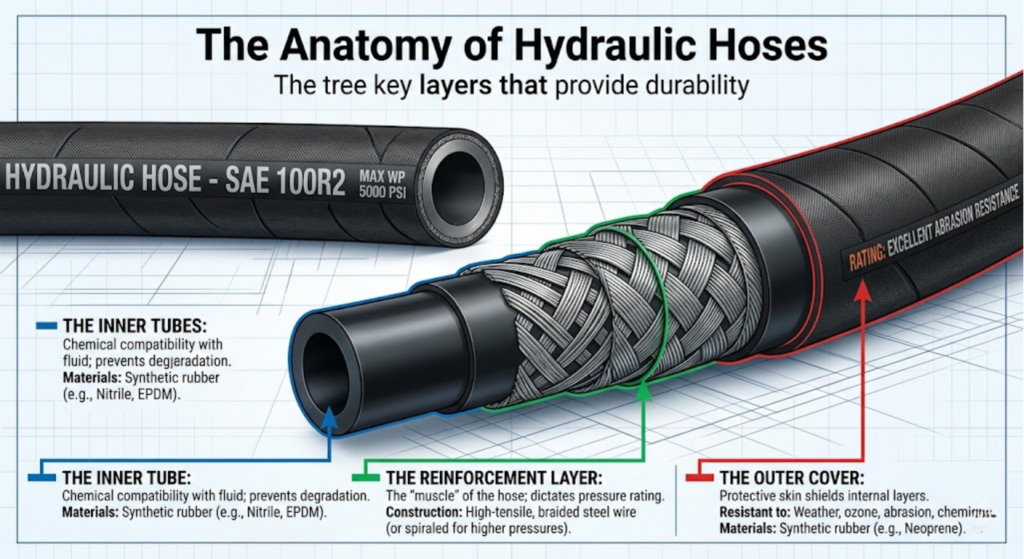
To understand why they are so durable, you must look at how hyd hoses are constructed. Every quality hose features a distinct three-layer design:
The Inner Tube: This is the innermost layer that makes direct contact with the hydraulic fluid. It must be chemically compatible with the fluid to prevent degradation.
The Reinforcement Layer: This is the muscle of the hose. Made from braided or spiraled steel wire, this layer dictates the pressure rating.
The Outer Cover: The protective skin. It shields the internal layers from weather, ozone, abrasion, and chemicals.
Common Types of Hyd Hoses
Not all fluid power lines are created equal. Depending on your industry, you will encounter three primary types of hyd hoses on the market today:
Braided Wire Hoses: These feature a crisscross wire pattern. These hyd hoses are ideal for low to medium-pressure applications and offer excellent flexibility for tight routing spaces.
Spiral Wire Hoses: Constructed with parallel steel wires wrapped tightly together, these heavy-duty hyd hoses are used for high-impulse, high-pressure machinery like excavators and mining equipment.
Thermoplastic Hoses: These are specialty hyd hoses designed for environments requiring extreme chemical resistance, low temperatures, or electrical non-conductivity (such as in utility cherry pickers).
Technical Specification Summary
Below is a quick reference table comparing the most common standard hyd hoses used in 2026 industrial applications.
| Hose Standard (SAE) | Reinforcement Type | Typical Pressure Range (PSI) | Best Application | Flexibility |
|---|---|---|---|---|
| 100R1 | Single Wire Braid | 1,000 – 3,000 | General purpose, light agriculture | Very High |
| 100R2 | Double Wire Braid | 2,000 – 6,000 | Standard industrial hydraulics | High |
| 100R12 | Four-Wire Spiral | Up to 4,000 | Heavy construction equipment | Moderate |
| 100R13 | Multiple Spiral | 5,000+ | High-impulse, extreme pressure | Low |
| 100R7 | Thermoplastic | 1,000 – 3,000 | Non-conductive environments | Moderate |
How to Choose the Right Hyd Hoses: The STAMPED Method
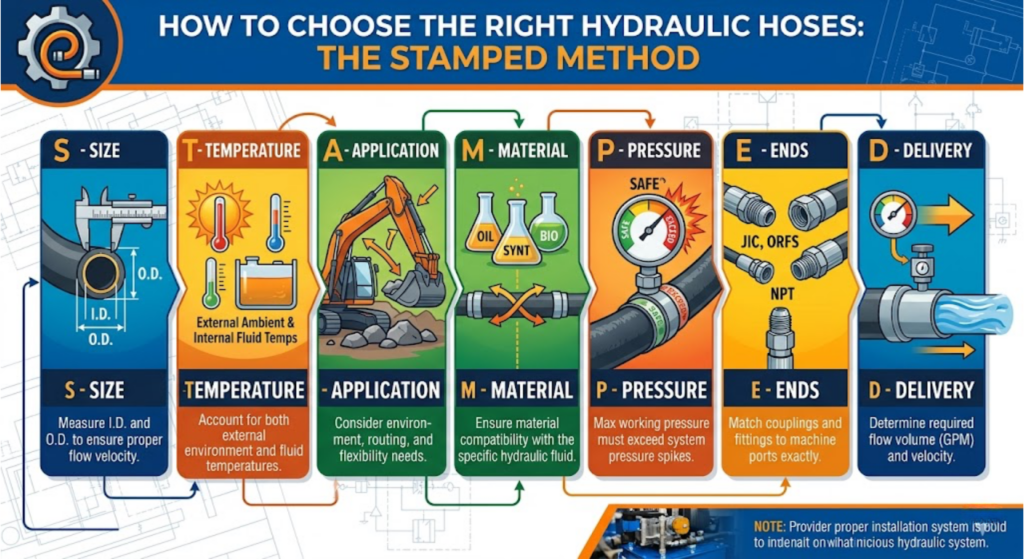
The gold standard for selecting hyd hoses is using the STAMPED acronym. This ensures you account for every variable before installation:
- S – Size: Measure the inner diameter (ID) and outer diameter (OD) to ensure proper flow velocity.
T – Temperature: Consider both the ambient external temperature and the internal fluid temperature.
A – Application: Where will it be used? Does it need extreme abrasion resistance?
M – Material: The hose material must be compatible with the specific hydraulic fluid being used.
P – Pressure: The maximum working pressure of the hyd hoses must always exceed the system’s maximum pressure spikes.
E – Ends: Ensure the couplings and fittings match the machine’s ports perfectly.
D – Delivery: Determine the volume and velocity of the fluid required by the system.
Maintenance and Lifespan of Hyd Hoses
Even the highest-quality components degrade over time. Replacing your hyd hoses proactively is much cheaper than dealing with sudden catastrophic machine failure. Routine maintenance should include weekly visual inspections. Look for signs of cover abrasion, exposed wire reinforcement, weeping fluid at the fittings, or soft spots in the rubber.
Furthermore, ensure that your hyd hoses are not installed with twists or routed in a way that violates their minimum bend radius. A ruptured line under extreme pressure is a severe safety hazard, and failed hyd hoses can cause costly environmental spills and massive downtime.
Key Points
Definition: Hyd hoses are flexible tubes designed to transport pressurized hydraulic fluid between machinery components.
Construction: They consist of an inner tube, a reinforced layer (wire braid or spiral), and a protective outer cover.
Selection: The STAMPED method (Size, Temperature, Application, Material, Pressure, Ends, Delivery) is the industry standard for choosing the right hose.
Lifespan: Routine inspection and preventing minimum bend radius violations are critical for longevity.