Chemical Resistant Industrial Hose India
In the rapidly evolving landscape of Indian manufacturing, safety and efficiency are the twin pillars of success. Whether you are operating a pharmaceutical plant in Gujarat or a chemical processing unit in Maharashtra, the integrity of your fluid transfer systems is non-negotiable. At the heart of these systems lies the chemical resistant industrial hoses Indiaindustries rely on to handle aggressive media, extreme temperatures, and high-pressure environments.
As India’s industrial sector targets a $5 trillion economy, the demand for specialized equipment that can withstand corrosive substances like sulfuric acid, nitric acid, and various solvents has reached an all-time high. This blog explores everything you need to know about selecting and maintaining a chemical resistant industrial hoses India businesses use for peak performance.
Why Quality Matters: The Role of Chemical Resistant Industrial Hose India
The primary function of a chemical resistant industrial hoses India is to facilitate the safe passage of hazardous fluids without degrading the hose material or contaminating the product. In India, where humidity and ambient temperatures can be extreme, a standard rubber hose simply won’t suffice.
Using an inferior chemical resistant industrial hoses India leads to:
-
Permeation: Where chemicals seep through the hose wall.
-
Corrosion: Resulting in structural failure and dangerous leaks.
-
Contamination: High-purity sectors like food and pharma cannot risk material leaching.
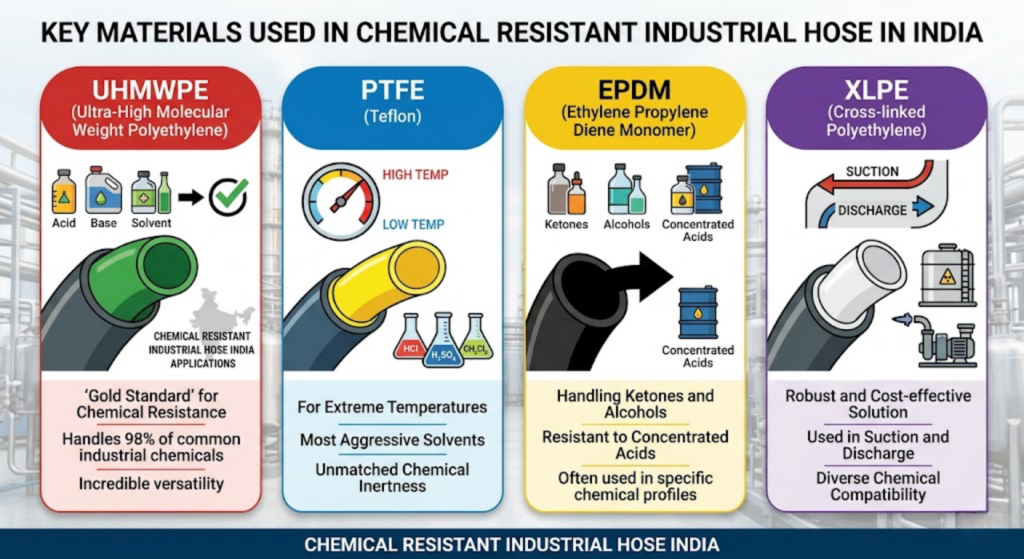
Key Materials Used in Chemical Resistant Industrial Hose India
When looking for a chemical resistant industrial hoses India suppliers offer, you will find several material compositions tailored for specific chemical profiles:
UHMWPE (Ultra-High Molecular Weight Polyethylene): Known for its incredible versatility, UHMWPE is the “gold standard” for a chemical resistant industrial hoses India application. It handles 98% of common industrial chemicals.
PTFE (Teflon): For extreme temperatures and the most aggressive solvents, PTFE-lined chemical resistant industrial hose India products provide unmatched chemical inertness.
EPDM (Ethylene Propylene Diene Monomer): Often used in a chemical resistant industrial hoses Indiadesigned for handling ketones, alcohols, and concentrated acids.
XLPE (Cross-linked Polyethylene): A robust and cost-effective solution for a chemical resistant industrial hoses India used in suction and discharge of diverse chemicals.
Industry Applications Across the Subcontinent
The versatility of the chemical resistant industrial hose India market caters to a wide array of sectors:
| Industry | Common Use Case for Chemical Resistant Industrial Hose India |
|---|---|
| Pharmaceuticals | Transfer of high-purity solvents and acids in cleanroom environments. |
| Petrochemicals | Handling aromatic hydrocarbons and aggressive fuel additives. |
| Agriculture | Distribution of liquid fertilizers and pesticides. |
| Manufacturing | Paint and ink transfer, involving strong solvents and dyes. |
Safety Standards and Compliance in India
Selecting a chemical resistant industrial hose India requires more than just picking a material; it requires checking for compliance. In the Indian market, look for hoses that meet BIS (Bureau of Indian Standards) such as IS 10733 or international equivalents like ISO 1307.
A certified chemical resistant industrial hose India ensures:
Burst Pressure Safety: Typically 3 or 4 times the working pressure.
Electrical Conductivity: Essential for preventing static build-up when transferring flammable chemicals.
Flexibility: Ensuring the chemical resistant industrial hose India can be used in tight industrial spaces without kinking.
How to Choose the Right Chemical Resistant Industrial Hose India
To optimize your selection process for a chemical resistant industrial hose India, use the S.T.A.M.P.E.D. method:
Size: ID, OD, and length.
Temperature: Both the fluid and the ambient Indian climate.
Application: Will it be used for suction, discharge, or both?
Material: The specific chemical being conveyed.
Pressure: Maximum working pressure required.
Ends: The type of fittings (Flanged, Camlock, or Threaded).
Delivery: Testing and certification requirements.
Maintenance Tips for Your Chemical Resistant Industrial Hose India
To maximize the lifespan of your chemical resistant industrial hose India, regular inspections are vital.
Visual Checks: Look for blisters, cracks, or soft spots on the outer cover.
Proper Storage: Store your chemical resistant industrial hose India in a cool, dry place away from direct sunlight (UV rays can degrade rubber).
Flushing: Always flush the chemical resistant industrial hose India after use to prevent residual chemical buildup that could eat away at the lining.
Conclusion
Investing in a high-quality chemical resistant industrial hose India is an investment in your facility’s safety and operational longevity. As Indian industries continue to modernize, the role of a reliable chemical resistant industrial hose India becomes even more critical in preventing downtime and environmental hazards.
Whether you are upgrading an existing line or setting up a new plant, always consult with a certified chemical resistant industrial hose India manufacturer to ensure your fluid transfer solutions are built to last.