
In the demanding world of industrial manufacturing, automotive engineering, and heavy-duty processing, temperature is often the enemy of efficiency. Standard materials brittle, crack, or melt when exposed to extreme thermal conditions. This is where the heat resistant rubber hose pipe becomes an unsung hero, ensuring that fluids, gases, and chemicals move safely through high-heat environments without catastrophic failure.
Whether you are managing a chemical plant or maintaining a high-performance engine, choosing the right heat resistant rubber hose pipe is a critical decision for both safety and longevity.
What Makes a Rubber Hose Heat Resistant?
Not all rubber is created equal. A standard garden hose would disintegrate in minutes if attached to an industrial boiler. A true heat resistant rubber hose pipe is engineered using specialized synthetic polymers designed to maintain structural integrity at temperatures that would liquefy standard plastics.
Common Materials Used:
- EPDM (Ethylene Propylene Diene Monomer): Known for its excellent resistance to heat, ozone, and weather. It is a staple for steam and hot water applications.
Silicone: Offers the widest temperature range, remaining flexible in freezing cold and stable in intense heat.
Viton (Fluoroelastomer): The “gold standard” for high-heat environments that also involve aggressive chemicals or fuels.
Nitril (NBR): While primarily oil-resistant, specific blends are used for a heat resistant rubber hose pipe in automotive fuel lines.
Key Industrial Applications
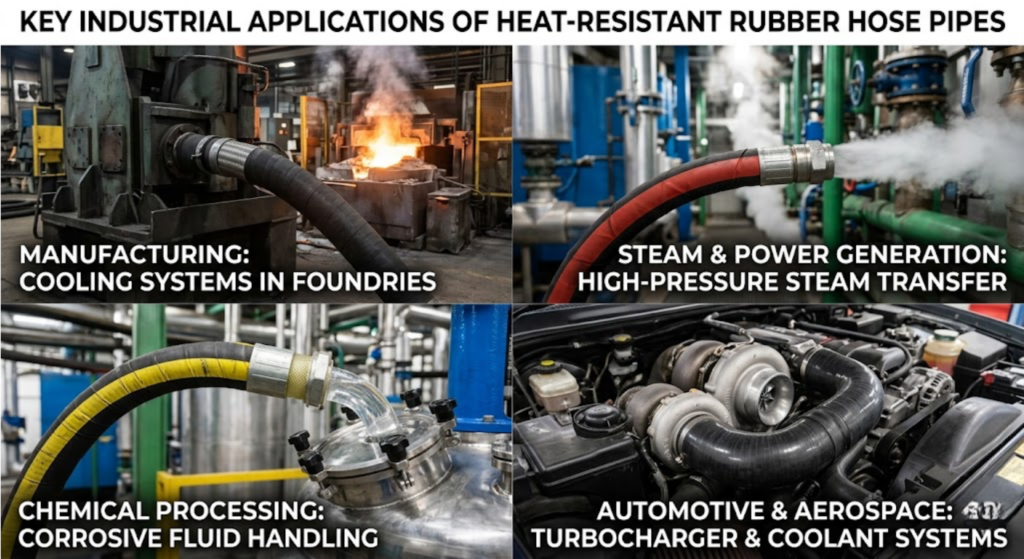
The versatility of a heat resistant rubber hose pipe allows it to serve multiple sectors. Here are the primary industries where these components are indispensable:
Automotive and Aerospace: From turbocharger hoses to coolant systems, these pipes must endure engine bay temperatures exceeding 150°C.
Manufacturing and Foundries: Moving molten glass or cooling heavy machinery requires a heat resistant rubber hose pipe that can withstand both internal fluid heat and external radiant heat.
Chemical Processing: High-temperature chemical reactions require transport systems that won’t degrade or leach contaminants into the mixture.
Steam and Power Generation: Handling pressurized steam is one of the most volatile tasks, demanding a specialized heat resistant rubber hose pipe reinforced with high-tensile wire.
Why You Shouldn’t Compromise on Quality
Investing in a high-quality heat resistant rubber hose pipe isn’t just about performance; it’s about risk management.
1. Thermal Stability
A premium heat resistant rubber hose pipe prevents “thermal hardening.” Lower-quality hoses become brittle over time, leading to cracks and leaks. High-end variants retain their flexibility, ensuring the hose can handle vibrations and movement without snapping.
2. Safety and Pressure Ratings
Temperature and pressure are intrinsically linked. As heat increases, the pressure-bearing capacity of a hose typically decreases. An optimized heat resistant rubber hose pipe is designed with multi-layer reinforcement (such as aramid fibers or stainless steel braiding) to maintain its burst pressure rating even at peak temperatures.
3. Longevity and Cost-Effectiveness
While the initial cost of a specialized heat resistant rubber hose pipe may be higher, the “cost per hour of operation” is significantly lower. Fewer replacements mean less downtime and lower labor costs for maintenance.
Selecting the Right Hose: Factors to Consider
To find the perfect heat resistant rubber hose pipe for your specific needs, use the S.T.A.M.P.E.D. method:
| Factor | Description |
|---|---|
| Size | The ID (Inside Diameter) and length required for flow efficiency. |
| Temperature | Both the internal fluid temperature and the external ambient temperature. |
| Application | Will the heat resistant rubber hose pipe be bent, submerged, or dragged? |
| Material | Compatibility between the hose liner and the substance being transported. |
| Pressure | The maximum working pressure and potential surges. |
| Ends | The type of couplings or fittings needed for a leak-proof seal. |
| Delivery | Testing requirements and certification (e.g., FDA or ISO standards). |
Maintenance Tips for High-Heat Hoses
Even the best heat resistant rubber hose pipe won’t last forever, but proper care can extend its life:
- Routine Inspection: Look for “cover cracking” or discoloration, which indicates the hose is reaching its thermal limit.
Proper Routing: Ensure the heat resistant rubber hose pipe isn’t touching a heat source directly (like an exhaust manifold) unless it is specifically rated for contact.
Avoid Over-Pressurization: Heat weakens the molecular bonds of rubber; pushing a hose to its limit in a hot environment accelerates wear.
Conclusion
Even the best heat resistant rubber hose pipe won’t last forever, but proper care can extend its life:
The heat resistant rubber hose pipe is a masterpiece of material science. By selecting the correct polymer and reinforcement, industries can operate at higher temperatures and higher efficiencies than ever before. When you choose a heat resistant rubber hose pipe, you aren’t just buying a tube; you are buying the peace of mind that your operations will remain fluid, safe, and productive, no matter how high the mercury rises.
Don’t wait for a failure to upgrade. Analyze your thermal requirements today and ensure you are using a heat resistant rubber hose pipe that is built to take the heat.