In 2026, the oil and gas industry runs on fluid under extreme pressure, temperature, and chemical stress—conditions that demand more than ordinary hoses. That’s why specialized Industrial Hose Manufacturers have become critical partners in drilling, fracking, refining, and offshore operations. These manufacturers don’t just sell rubber tubes; they deliver engineered solutions that directly affect safety, uptime, and regulatory compliance.
What makes Industrial Hose Manufacturers for oil & gas different
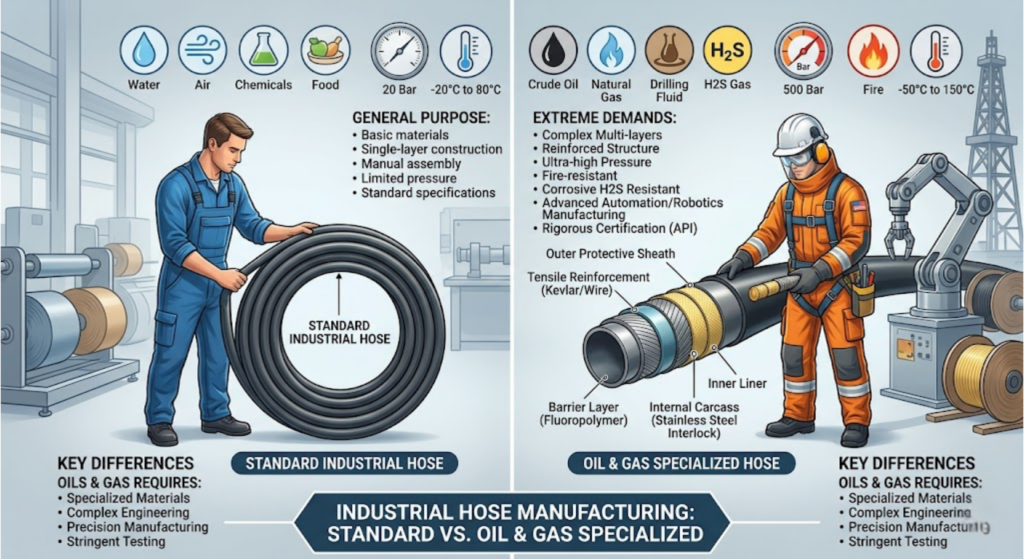
Industrial Hose Manufacturers serving oil & gas must meet some of the toughest standards in the world—API 7K, API 16C, ISO 1823, and other regional codes that govern drilling, well‑control, and pipeline‑transfer systems. Unlike general‑purpose hose suppliers, these Industrial Hose Manufacturers use specially formulated compounds, multi‑layer reinforcements, and rigorous testing protocols to ensure hoses can withstand thousands of pressure cycles, exposure to crude, chemicals, seawater, and high‑temperature environments.
Another key difference is customization. Oil fields and offshore platforms rarely use standard “off‑the‑shelf” hose assemblies. Industrial Hose Manufacturers design bespoke lengths, bend radii, coupling types, and protective coatings to match specific rig layouts, subsea BOP (blowout preventer) systems, and chemical‑injection lines.
Core design and material requirements
Oil‑resistant inner tubes made from nitrile rubber, fuel‑resistant thermoplastics, or specialized PTFE‑based compounds are standard among Industrial Hose Manufacturers for oil & gas. These materials resist degradation from crude, diesel, methanol, and other hydrocarbons that would quickly break down ordinary hoses.
Reinforcement is equally critical. Multi‑spiral steel‑wire layers and high‑tensile braids allow Industrial Hose Manufacturers to build hoses rated for pressures up to 3,000–4,000 bar in some ultra‑high‑pressure control and hydraulic‑test lines. Outer covers are engineered to be abrasion‑resistant, UV‑stable, and often anti‑static, which is essential in flammable atmospheres where static discharge can trigger fires or explosions.
Working in harsh offshore and onshore environments
Offshore platforms, FPSOs (floating production storage and offloading vessels), and deep‑sea installations place extraordinary demands on hose systems. Industrial Hose Manufacturers now produce ultra‑high‑pressure hose bundles that can run several kilometers underwater, handling chemical injections, methanol service, and control‑fluid transfer for subsea BOPs. These hoses must remain flexible despite extreme cold, salinity, and the constant movement of floating structures.
On land, shale‑field operations and hydraulic fracturing units rely on Industrial Hose Manufacturers to supply choke‑and‑kill lines, drilling‑fluid hoses, and high‑pressure frac‑water lines that endure repeated coiling, vibration, and abrasive contact with sand and gravel. Leading Industrial Hose Manufacturers respond by offering abrasion‑resistant covers, robust couplings, and pre‑assembled hose strings that reduce field‑assembly time and leak points.
Safety, compliance, and traceability
In oil & gas, a single hose failure can lead to spills, fires, or even catastrophic well‑control events. Industrial Hose Manufacturers therefore implement strict quality‑control systems, including burst testing, impulse‑cycle testing, and kink testing at representative operating conditions. Many manufacturers now include digital traceability, so each hose assembly carries a unique identifier linking it to batch certificates, test records, and installation history.
Certifications and documentation are equally important. Industrial Hose Manufacturers supplying oil & gas projects typically provide full technical dossiers compliant with API, ISO, and regional safety frameworks. This documentation helps operators satisfy environmental and safety‑audit requirements while also speeding up approval and commissioning processes.
Emerging trends among Industrial Hose Manufacturers in 2026
By 2026, Industrial Hose Manufacturers serving oil & gas are moving toward lighter, higher‑performance constructions that reduce weight on rigs and offshore structures without sacrificing pressure rating. Some manufacturers are also exploring composite‑reinforced hoses and fiber‑based materials that combine flexibility with improved chemical resistance and fatigue life.
Another growing trend is integrated service models. Beyond supplying hoses, Industrial Hose Manufacturers now offer installation support, on‑site training, and predictive‑maintenance programs that monitor hose life through inspection schedules and usage data. For operators, this shift means fewer unplanned shutdowns and more predictable replacement cycles in an industry where every hour of downtime is costly
Why choosing the right Industrial Hose Manufacturers matters
In 2026, the oil and gas sector can no longer treat hoses as a low‑cost, throwaway component. Instead, Industrial Hose Manufacturers are viewed as strategic partners whose products directly influence operational safety, environmental performance, and project economics. By selecting proven Industrial Hose Manufacturers who combine advanced materials, rigorous testing, and global‑standard certifications, operators ensure that their fluid‑transfer systems remain among the most reliable and resilient parts of the entire value chain.