
PVC Hoses vs Rubber Hoses
In the evolving landscape of 2026, where industrial efficiency meets a heightened focus on sustainability, selecting the right material for fluid and gas transfer is more critical than ever. Whether you are managing a high-scale manufacturing plant or simply upgrading your home workshop, the debate between PVC and rubber remains a central topic for professionals globally.
While both materials have undergone significant chemical advancements over the last few years, they serve distinct purposes. This guide breaks down the core differences between PVC and rubber hoses in 2026 to help you make an informed investment.
The Evolution of Materials in 2026
Historically, the choice was simple: PVC was cheap and stiff, while rubber was expensive and flexible. In 2026, the lines have blurred slightly due to the rise of hybrid polymers, but the fundamental DNA of these materials still dictates their best use cases. Manufacturers are now producing pvc hose that mimic the feel of rubber, yet significant performance gaps remain.
1. Temperature Resilience and Flexibility
The most immediate difference you will notice is how these materials react to the environment.
-
Rubber Hoses:
Traditionally made from EPDM (Ethylene Propylene Diene Monomer) or Nitrile, modern rubber hoses are the undisputed kings of temperature range. In 2026, high-grade synthetic rubber can withstand temperatures from -40°C to 120°C without losing its structural integrity. It remains supple in freezing winters, preventing the “coiling battle” many users face. -
PVC Hoses:
Polyvinyl Chloride is a thermoplastic. While 2026 formulations have improved, standard pvc hosesare still susceptible to “thermal hardening.” In cold weather, they can become brittle and prone to cracking. Conversely, in extreme heat, pvc hoses may soften significantly, which can lead to kinking or a reduction in pressure rating.
2. Durability and Abrasion Resistance
If your hose is going to be dragged across gravel, concrete, or factory floors, durability is your primary metric.
PVC hoses are prized for being lightweight and resistant to many chemicals and salts. However, they lack the “self-healing” or rugged exterior of rubber. In 2026, premium pvc hoses are often reinforced with high-tensile polyester braiding to improve their burst pressure. Despite this, pvc hoses remain more vulnerable to pinhole punctures and external abrasions compared to their rubber counterparts.
Rubber is naturally more “elastic.” It absorbs impact and resists the cutting action of sharp edges. This makes rubber the preferred choice for heavy-duty construction sites and automotive environments where the hose is constantly in motion.
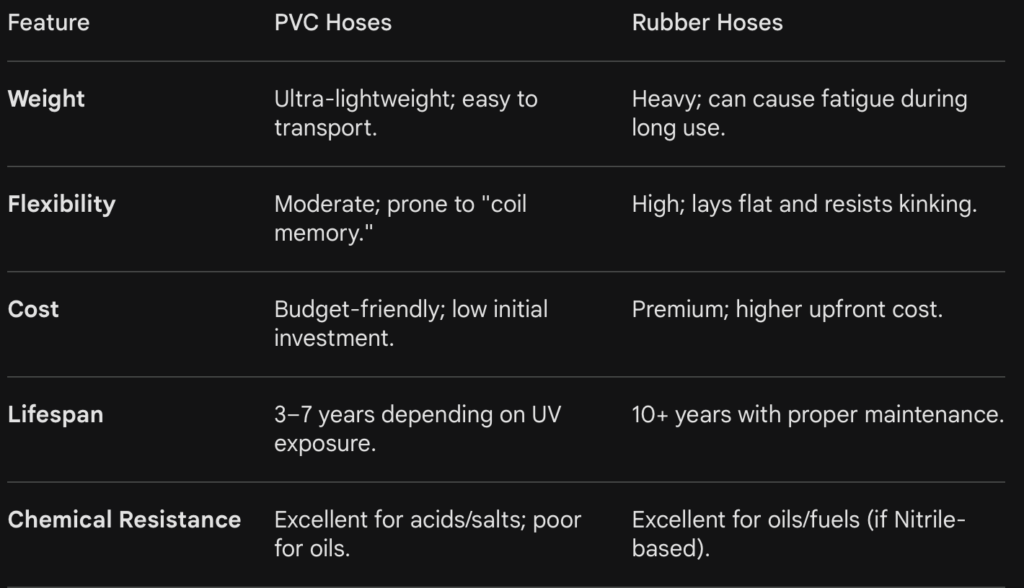
Comparison Table: PVC vs. Rubber (2026 Standards)
Sustainability and Eco-Impact
In 2026, the “green” factor is a major tie-breaker for procurement officers and eco-conscious homeowners.
Modern pvc hoses have made huge strides in recyclability. Manufacturing now utilizes non-phthalate plasticizers, making pvc hoses safer for drinking water (look for “Lead-Free” and “BPA-Free” labels). Because they are lighter, pvc hoses also have a smaller carbon footprint during shipping, reducing the overall environmental impact of the supply chain.
Rubber, particularly synthetic EPDM, is incredibly long-lasting, which supports a “buy it once” philosophy. However, rubber is significantly harder to recycle than pvc hoses. Many 2026 brands are now countering this by using reclaimed rubber content in the middle layers of their hoses to balance durability with environmental responsibility.
When to Choose PVC Hoses?
Despite the ruggedness of rubber, pvc hoses are often the smarter choice for specific applications:
-
Light Gardening:
The lightweight nature of pvc hoses makes them perfect for homeowners who don’t want to lug heavy equipment around the yard. -
Indoor Food & Beverage:
Clear pvc hoses allow for visual inspection of the fluid, which is vital in food-grade and medical applications. -
Static Air Lines:
In a shop where the line stays mounted to a reel, the weight advantage of pvc hoses makes them much easier to manage over long shifts. -
Budget-Conscious Projects:
When the application is low-pressure and the environment is controlled, pvc hosesoffer the best ROI.
The Final Verdict
If you need a tool that can survive a decade of abuse, sub-zero temperatures, and high-pressure surges, rubber is your winner. However, if portability, chemical clarity, and cost-effectiveness are your priorities, modern pvc hoses are more capable today than they have ever been.