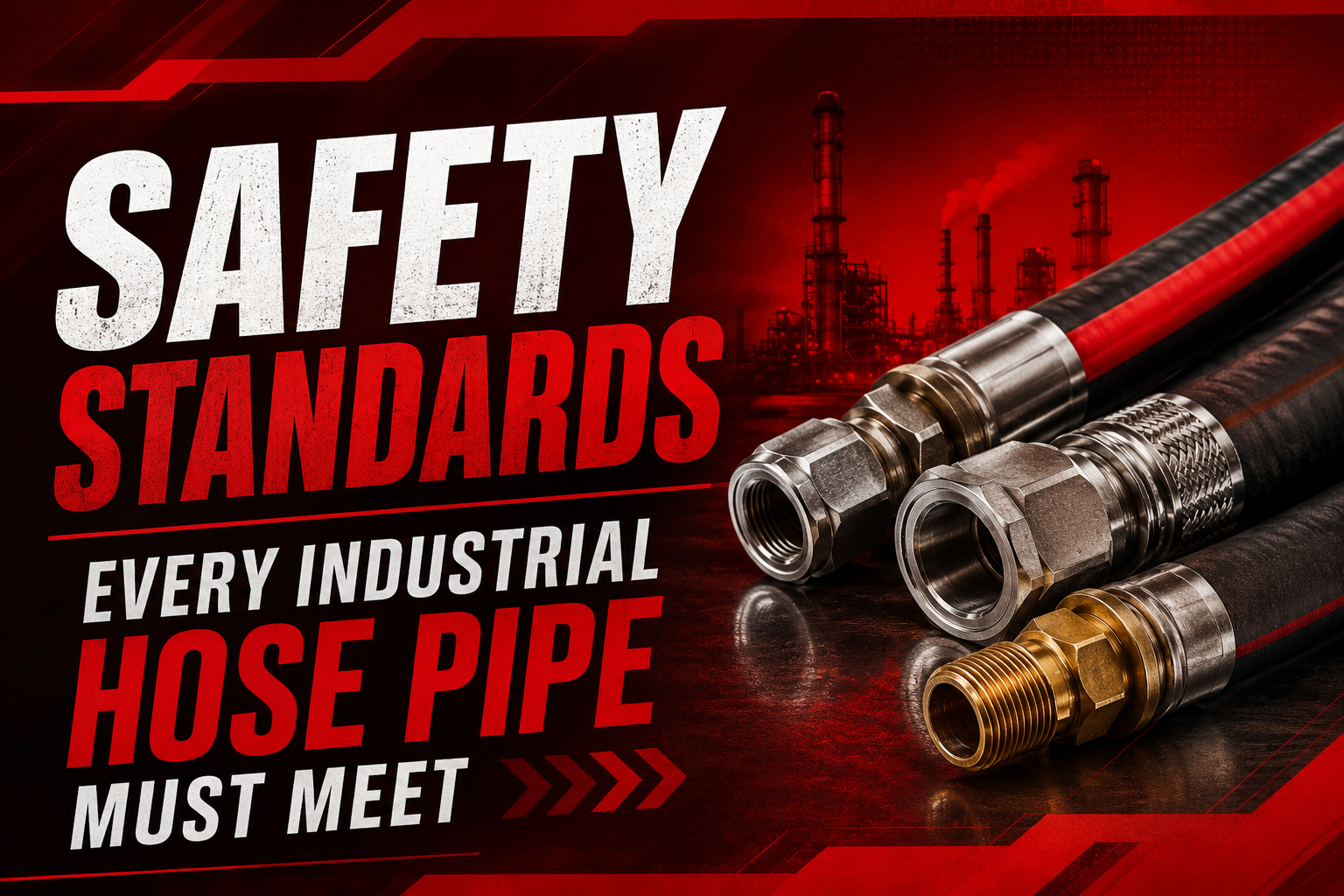
Industrial operations rely on a wide range of equipment to ensure smooth and uninterrupted performance. Among the most critical components used across manufacturing, construction, chemical processing, mining, agriculture, and transportation sectors is the industrial hose pipe. Whether it is transferring water, chemicals, air, oil, or hydraulic fluids, the quality and safety of a hose directly impact operational efficiency and workplace safety.
Despite being a common industrial component, hoses are often overlooked until a failure occurs. A burst hose, chemical leak, pressure loss, or contamination issue can result in costly downtime, equipment damage, and serious safety risks. This is why every industrial hose pipe must comply with specific safety standards before being deployed in industrial environments.
Understanding these standards helps businesses make informed purchasing decisions and ensures long-term reliability. In this guide, we will explore the essential safety standards that every industrial hose pipe should meet and why compliance matters for industrial applications.
Why Safety Standards Matter for Industrial Hose Pipes
Every industrial facility operates under strict safety requirements. Hoses are frequently exposed to high pressure, extreme temperatures, abrasive materials, chemicals, and continuous mechanical stress. Without proper manufacturing standards, even a high-quality-looking hose can become a safety hazard.
Can a small hose failure lead to major production losses?
The answer is yes. A damaged or non-compliant industrial hose pipe can cause fluid leakage, pressure drops, contamination, environmental hazards, and unexpected shutdowns. This is why industries prioritize certified products from a trusted industrial hose pipe manufacturer that follows recognized quality and safety standards.
Safety standards ensure that hoses are tested, inspected, and manufactured to withstand their intended operating conditions while maintaining consistent performance.
ISO Standards for Industrial Hose Pipes
One of the most recognized quality benchmarks globally is the International Organization for Standardization (ISO). Many industries prefer an industrial hose pipe that complies with ISO standards because these standards establish requirements for performance, durability, and testing procedures.
ISO-compliant hoses undergo rigorous assessments for pressure resistance, flexibility, dimensional accuracy, and material quality. These standards are particularly important for applications involving industrial rubber hose pipe systems where performance consistency is essential.
ISO certification also helps buyers verify that a hose has been manufactured under controlled processes and quality management systems.
Pressure Rating and Burst Pressure Standards
Every industrial hose pipe is designed to operate within a specific pressure range. One of the most important safety requirements is ensuring that the hose can safely withstand both working pressure and burst pressure.
Working pressure refers to the maximum pressure at which the hose can continuously operate. Burst pressure represents the pressure level at which the hose fails during testing.
Industry standards generally require burst pressure ratings to be significantly higher than the working pressure to provide an adequate safety margin. This safety factor helps prevent accidents caused by pressure spikes during operation.
Whether it is a Pneumatic hose pipe carrying compressed air or a hydraulic hose transporting fluid under high pressure, pressure testing remains a fundamental safety requirement.
Material Safety and Construction Standards
The material composition of an industrial hose pipe determines its ability to withstand different industrial environments.
Manufacturers carefully select materials based on application requirements. For example, an industrial rubber hose pipeused in construction sites requires excellent abrasion resistance, while a Chemical hose pipe must resist corrosion and chemical degradation.
Material safety standards evaluate:
Resistance to wear and abrasion
Resistance to environmental exposure
Temperature tolerance
Chemical compatibility
Flexibility under operating conditions
Structural integrity
A reliable industrial hose pipe manufacturer ensures that hose materials meet the specifications required for their intended use.
Chemical Resistance Standards
Many industrial facilities transport acids, solvents, petroleum products, and other aggressive substances. In such cases, selecting a compliant Chemical hose pipe becomes essential.
How can industries safely transport hazardous chemicals without risking leaks or contamination?
The answer lies in chemical resistance testing. Safety standards require hoses to be tested against specific chemicals to evaluate swelling, cracking, degradation, and permeability.
A certified Chemical hose pipe is designed to maintain its structural integrity even when exposed to harsh industrial chemicals for extended periods. This helps protect workers, equipment, and the surrounding environment.
Temperature Resistance Requirements
Industrial environments often expose hoses to extremely high or low temperatures. Temperature fluctuations can weaken hose materials, reduce flexibility, and increase the likelihood of failure.
A compliant industrial hose pipe must meet temperature resistance requirements established by industry standards. Manufacturers conduct tests to determine how the hose performs under continuous heat, cold conditions, and sudden temperature changes.
This testing is especially important for Rubber hose pipe applications used in foundries, manufacturing facilities, and outdoor industrial operations.
Temperature-resistant hoses help maintain operational safety while extending service life.
SAE Standards for Hydraulic Hose Applications
Hydraulic systems require specialized hoses capable of handling fluid transfer under pressure. Among the most widely recognized hydraulic standards are those established by the Society of Automotive Engineers (SAE).
Two commonly used products are SAE R4 hose pipes and SAE R6 hose pipes.
SAE R4 hose pipes are typically designed for low-pressure hydraulic return lines and suction applications. These hoses must meet strict requirements related to vacuum resistance, flexibility, and durability.
SAE R6 hose pipes are used in low-pressure hydraulic systems where flexibility and reliable fluid transfer are important. Safety standards ensure these hoses maintain performance under varying operating conditions.
When selecting hydraulic hoses, verifying SAE compliance is critical to preventing premature hose failure and maintaining system safety.
Reinforcement and Structural Integrity Testing
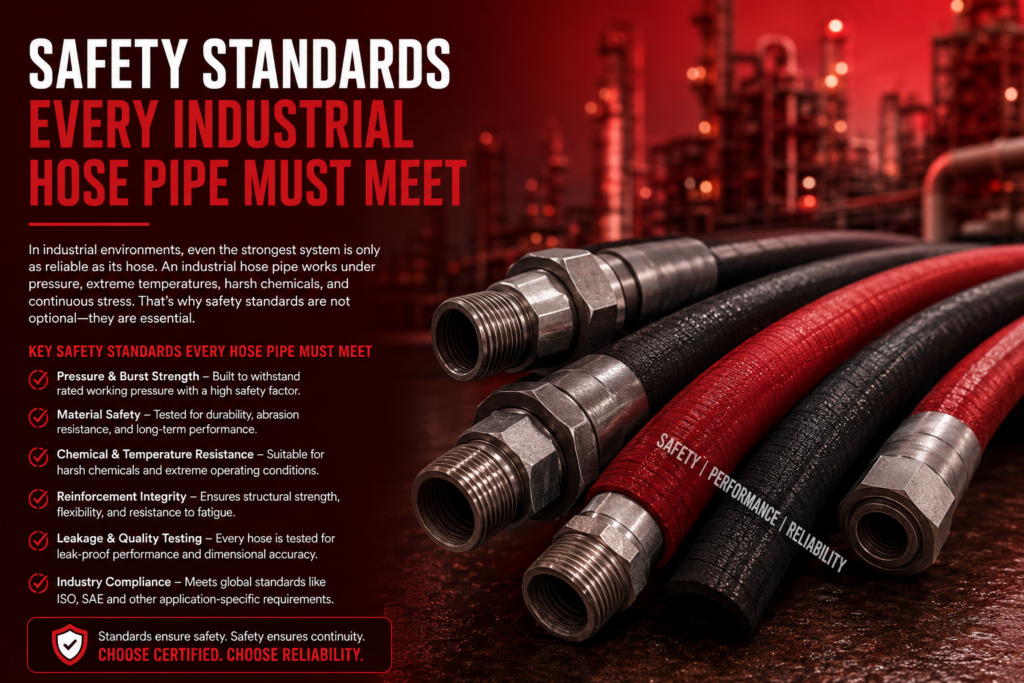
An industrial hose pipe consists of multiple layers working together to provide strength and flexibility. Safety standards require extensive testing of reinforcement materials such as textile braids, wire reinforcements, and synthetic fibers.
These tests assess:
Tensile strength
Flexibility
Crush resistance
Pressure retention
Fatigue resistance
Structural reinforcement is especially important for industrial rubber hose pipe products used in demanding industrial environments where continuous movement and pressure fluctuations occur.
A properly reinforced hose delivers reliable performance while minimizing operational risks.
Leakage and Quality Inspection Standards
Leakage prevention is a key objective of hose safety standards. Even minor leaks can result in product loss, environmental contamination, and safety hazards.
Manufacturers conduct hydrostatic testing, air pressure testing, and vacuum testing to verify the integrity of every industrial hose pipe.
Quality inspection procedures typically include:
Visual inspections
Dimensional checks
Pressure testing
Material verification
Performance testing
These inspections ensure that every hose meets safety requirements before reaching the customer.
Industry-Specific Compliance Requirements
Different industries have unique hose safety requirements. The industrial hose pipe use in industries varies significantly depending on the application.
Chemical processing facilities focus heavily on chemical resistance standards.
Food processing industries require contamination-resistant materials.
Mining operations prioritize abrasion resistance and durability.
Construction projects often require high-pressure performance.
Manufacturing facilities demand flexibility and long service life.
Because of these varying needs, businesses should always select products designed specifically for their operating environment.
The Role of a Reliable Manufacturer
Choosing the right industrial hose pipe manufacturer is just as important as selecting the correct hose type. Reputable manufacturers invest in advanced testing equipment, quality control systems, and compliance certifications.
A trusted manufacturer ensures that every industrial hose pipe undergoes thorough testing before it reaches the market. This reduces the likelihood of operational failures and helps businesses maintain safety compliance.
Working with experienced manufacturers also provides access to technical guidance when selecting products such as Rubber hose pipe, Chemical hose pipe, Pneumatic hose pipe, SAE R4 hose pipes, and SAE R6 hose pipes for specific industrial applications. Industrial hose failures can lead to costly downtime, safety risks, and operational disruptions. Understanding the safety standards behind every industrial hose pipe is essential for ensuring reliable performance and workplace safety.
Read the full blog and discover how choosing the right hose can improve safety, efficiency, and long-term reliability.
Conclusion
Safety standards are the foundation of reliable hose performance. Every industrial hose pipe used in industrial operations should comply with recognized standards covering pressure resistance, material quality, chemical compatibility, temperature tolerance, structural integrity, and leakage prevention.
From industrial rubber hose pipe solutions used in manufacturing to specialized Chemical hose pipe systems and hydraulic products like SAE R4 hose pipes and SAE R6 hose pipes, compliance with industry standards ensures safety, durability, and long-term operational efficiency.
Businesses that understand the importance of these standards can make better purchasing decisions, reduce maintenance costs, improve workplace safety, and achieve greater reliability in their industrial operations. Partnering with a trusted industrial hose pipe manufacturer remains one of the most effective ways to ensure compliance and performance in today’s demanding industrial environments.
FAQs
Compliance ensures that an industrial hose pipe meets safety, performance, and durability requirements, reducing the risk of failures, leaks, and workplace accidents.
Common standards include ISO certifications, SAE specifications, pressure testing requirements, and industry-specific safety guidelines.
SAE R4 hose pipes are generally used for hydraulic suction and return lines, while SAE R6 hose pipes are designed for low-pressure hydraulic fluid transfer applications.
Chemical resistance testing ensures that a Chemical hose pipe can safely transport aggressive substances without degrading, leaking, or contaminating materials.
Look for a manufacturer with proven industry experience, quality certifications, testing facilities, and a strong reputation for supplying reliable hose solutions.