
In 2026, hydraulic hoses are no longer just pipes carrying fluid—they are the backbone of modern Hoses Machinery, enabling everything from construction cranes and mining shovels to agricultural combines and factory robots to move with precision and power. At the heart of this transformation lies the Hydraulic Hose Factory, a high‑tech ecosystem where engineering, materials science, and automation come together to build the arteries of industrial civilization.
What a Hydraulic Hose Factory actually does
A Hydraulic Hose Factory is a specialized manufacturing unit that designs, extrudes, braids, and assembles hydraulic hoses used in Hoses Machinery such as excavators, presses, forklifts, and industrial presses. These facilities don’t just cut and join hoses; they control the entire chain from raw rubber, thermoplastic, and wire to fully tested, pressure‑rated hose assemblies. By 2026, many Hydraulic Hose Factories in India and abroad operate with near‑automated production lines, robotic braiders, and in‑line quality checks that ensure every hose can withstand the exact conditions demanded by modern Hoses Machinery.
Within a Hydraulic Hose Factory, the workflow typically starts with material selection. Engineers choose the right inner tube polymer, reinforcement layers (braided or spiral wire), and outer cover based on the target application—construction, mining, agriculture, or factory automation. For heavy‑duty Hoses Machinery, multi‑layer spiral hoses with high‑intensity steel wire reinforcement have become the norm, while lighter‑duty machines use braided constructions that balance flexibility and strength.
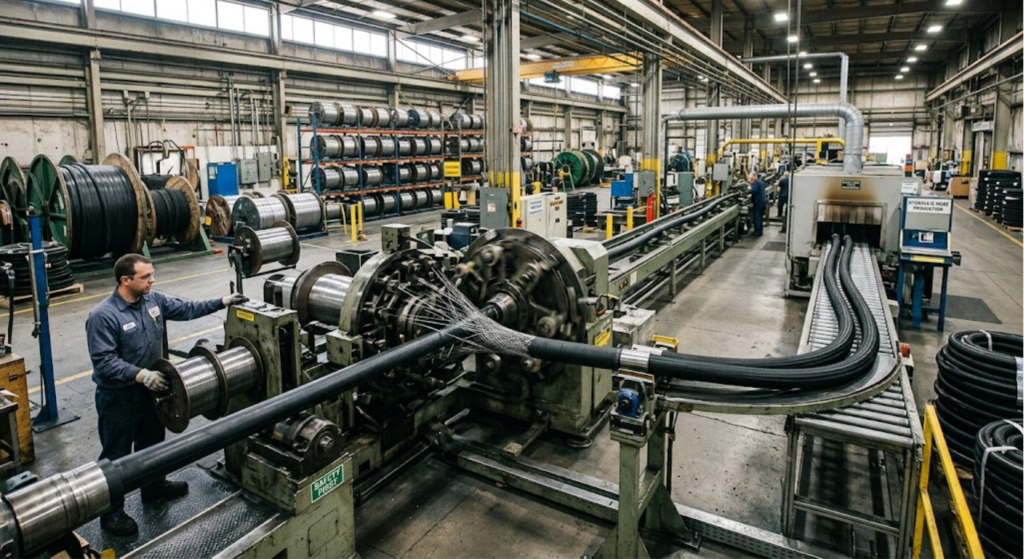
Inside the 2026 Hydraulic Hose Factory
By 2026, leading Hydraulic Hose Factories are increasingly “smart” facilities. Sensors monitor temperature, pressure, and curing time in real time, while automated braiding machines lay hundreds of steel or synthetic filaments in precise, symmetrical patterns. A single production line can convert raw rubber into fully assembled hydraulic hoses at speeds that would have been unimaginable a decade ago.
Another key upgrade in 2026 is digital traceability. Each hose assembly manufactured in a Hydraulic Hose Factory carries a unique code linking it to batch data, test results, and even the machine that produced it. This traceability is critical for Hoses Machinery OEMs (original equipment manufacturers), who need to guarantee that every valve, cylinder, and pump in their systems is connected by hoses that meet strict safety and performance standards. Many factories now integrate their data with quality‑management systems, allowing OEM engineers to audit hose performance across fleets and regions.
How Hydraulic Hoses enable modern Hoses Machinery
Modern Hoses Machinery relies on hydraulic hoses to transmit power in ways that mechanical linkages or electric cables cannot. In an excavator, for example, the boom, dipper, and bucket move through hydraulic cylinders connected by high‑pressure hoses made in a Hydraulic Hose Factory. These hoses must flex constantly, endure vibration, resist abrasion from rocks and debris, and still maintain a leak‑free seal for thousands of operating hours.
In factory automation, Hoses Machinery such as presses, injection‑molding units, and robotic arms use hydraulic hoses to generate precise force and motion. High‑pressure thermoplastic or PTFE hoses, often produced in specialized Hydraulic Hose Factories, protect systems from contamination and allow for cleaner, more compact machine layouts. Even in agriculture, combine harvesters and sprayers depend on hydraulic hoses to control hydraulic‑driven augers, reels, and spray booms, making the Hydraulic Hose Factory a quiet yet essential enabler of modern farming Hoses Machinery.
The materials and engineering behind Hoses Machinery hoses
Behind every Hydraulic Hose Factory product is a careful blend of materials engineered for the demands of Hoses Machinery. Inner tubes are typically made from nitrile rubber, thermoplastic elastomers, or PTFE, chosen for their resistance to various oils, fuels, and industrial fluids. The reinforcement layer—often steel wire or synthetic fiber—provides the tensile strength needed to handle pressures ranging from a few hundred to several thousand psi. Outer covers, usually made from abrasion‑resistant rubber or plastic, shield the hose from environmental damage such as UV exposure, ozone, and mechanical wear.
In 2026, many Hydraulic Hose Factories are also experimenting with composite materials and hybrid constructions that reduce weight while maintaining or even improving pressure capacity. Lightweight hoses are especially important for mobile Hoses Machinery like skid‑steer loaders and compact excavators, where every kilogram saved translates into better fuel efficiency and maneuverability.
Quality, safety, and the future of Hydraulic Hose Factories
In 2026, the top Hydraulic Hose Factories are judged not just by output volume but by safety, reliability, and longevity of their hoses in Hoses Machinery. Regular pressure‑testing, burst‑testing, pulse‑testing, and resistance‑to‑bending tests are standard practice. Many factories now simulate the full operating life of a hose in accelerated‑life tests, ensuring that when a hose goes into a piece of Hoses Machinery, it will perform reliably for years.
Looking ahead, Hydraulic Hose Factories are increasingly integrating predictive‑maintenance concepts into their operations. Smart sensors embedded in hoses can detect early signs of wear, such as micro‑cracks or pressure irregularities, and feed this data back to both the machinery operator and the factory. This vision of a “connected hose” reinforces the idea that Hydraulic Hose Factories are not just manufacturers—they are partners in the evolution of Hoses Machinery, providing the flexible, high‑performance arteries that keep modern industry moving.
In 2026, the Hydraulic Hose Factory story is no longer just about making hoses; it is about building the hidden backbone of all Hoses Machinery that powers construction, industry, and agriculture worldwide.