
High-pressure hoses industrial world of 2026 is moving faster, pushing harder, and demanding more from every component. At the heart of this movement is the high-pressure hydraulic hose—a component that has transitioned from a simple fluid conduit into a high-tech, data-driven powerhouse. As heavy machinery becomes more compact and autonomous, the hydraulic systems powering them have had to undergo a radical redesign.
In 2026, the focus has shifted toward extreme power density, operational intelligence, and unprecedented longevity. We are no longer just looking at how much pressure a hose can hold, but how much information it can provide and how easily it can be integrated into a complex, AI-driven environment.
Lorem ipsum dolor sit amet, consectetur adipiscing elit. Ut elit tellus, luctus nec ullamcorper mattis, pulvinar dapibus leo.
The 2026 High-Pressure Innovation Matrix
The following table provides a comprehensive overview of the technologies that are currently setting the pace for the industry.
| Technology | Technical Implementation | Core Benefit | Industry Impact |
|---|---|---|---|
| Smart-Core Sensing | Piezoelectric layers integrated into the hose carcass. | Real-time Fatigue Analysis: Identifies wire braid stress before failure. | Mining & Deep-Sea Drilling |
| Graphene-Reinforced Covers | Outer layers infused with carbon nanotubes and graphene. | Indestructible Armor: Up to 50 times more abrasion resistance than standard rubber. | Heavy Construction (JCBs, Cranes) |
| Cryo-Flex Polymers | Synthetic elastomers that remain flexible at -60°C. | Cold-Weather Reliability: Prevents cracking in extreme Arctic or high-altitude conditions. | Aerospace & Logistics |
| Zero-Drop Modular Fittings | Titanium-alloy “Push-Lock” connections for 500+ bar. | Rapid Field Repair: Tool-free hose replacement in under 2 minutes. | Emergency & Military Services |
| Hybrid Aramid-Steel Braid | A proprietary weave of synthetic fibers and high-tensile steel. | Weight Reduction: 30% lighter than traditional hoses with the same pressure rating. | Mobile Robotics & Agri-Tech |
1. The Era of the "Intelligent Fluid Path"
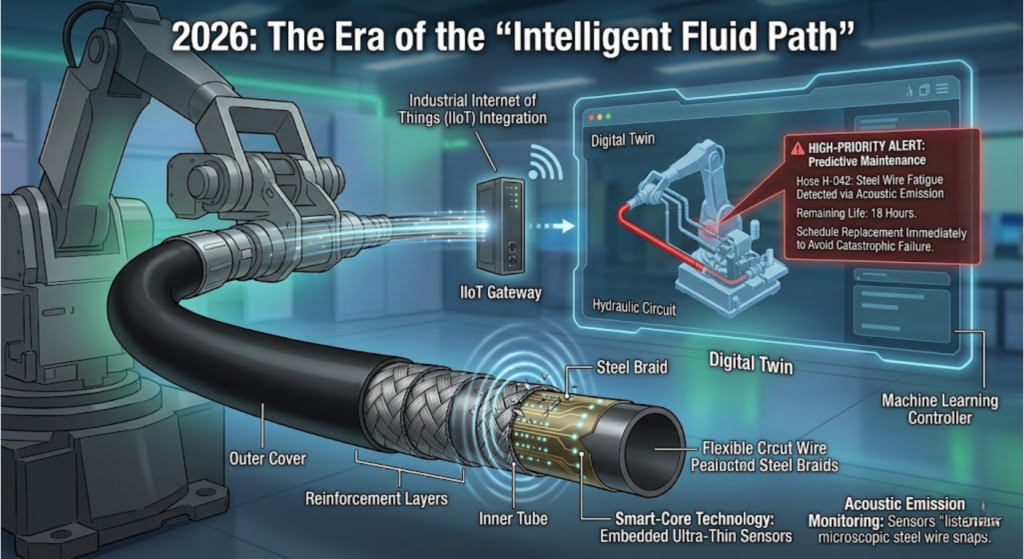
In 2026, the “dumb” hose is a thing of the past. Modern high-pressure lines now feature Smart-Core Technology. By embedding ultra-thin sensors between the inner tube and the reinforcement layers, these hoses can monitor internal conditions with surgical precision.
Acoustic Emission Monitoring: These sensors “listen” for the microscopic snapping of steel wires within the reinforcement braid.
Predictive Maintenance: Before a hose bursts—which can cause catastrophic machine failure or environmental contamination—the system sends a high-priority alert to the operator’s dashboard or mobile device. This integration into the Industrial Internet of Things (IIoT) allows for a “digital twin” of the entire hydraulic circuit, ensuring that every hose is replaced exactly when needed—neither too early (saving money) nor too late (avoiding disaster).
2. Pushing the Limits: 700 Bar and Beyond
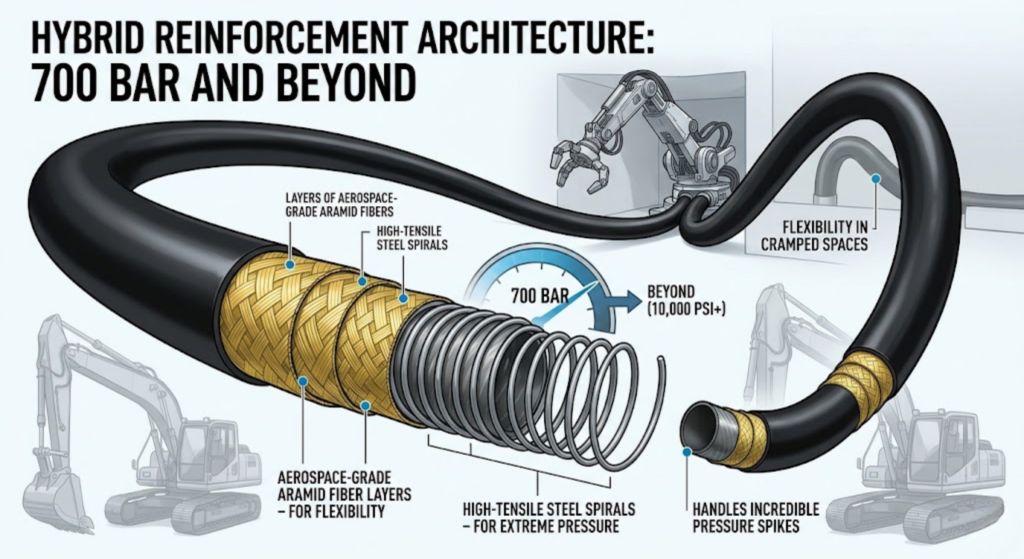
As hydraulic cylinders shrink to fit into smaller, more efficient machines, the pressure required to maintain power must increase. In 2026, the industry has seen a widespread transition from the traditional 350 bar (5,000 psi) standard to 700 bar (10,000 psi) capabilities in standard-diameter hoses.
This is achieved through Hybrid Reinforcement Architecture. By combining high-tensile steel spirals with layers of aerospace-grade aramid fibers, manufacturers have created hoses that handle incredible pressure spikes without the “stiffness” of traditional heavy-duty hoses. This flexibility is critical for modern excavators and robotic arms that require a high degree of motion in cramped spaces.
3. Surface Science: Graphene and Beyond
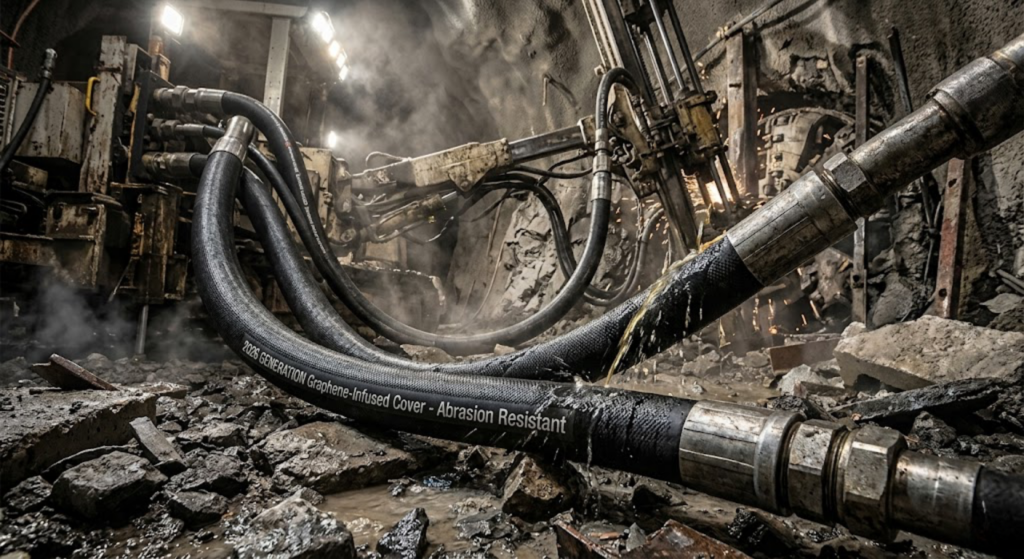
The exterior of a hydraulic hose is often its weakest point, prone to damage from rocks, concrete, and metal-on-metal friction. The 2026 generation of hoses features Nano-Infused Covers. By integrating graphene into the outer elastomer, manufacturers have created a “skin” that is nearly immune to abrasion.
Uptake in Heavy Industry: These hoses are being deployed in tunnels and mines where external wear usually cuts hose life by half.
Chemical Immunity: These new covers are also highly resistant to ozone, UV radiation, and aggressive chemicals, allowing the same hose model to be used in vastly different environmental conditions.
4. Sustainability and the "End-of-Life" Protocol
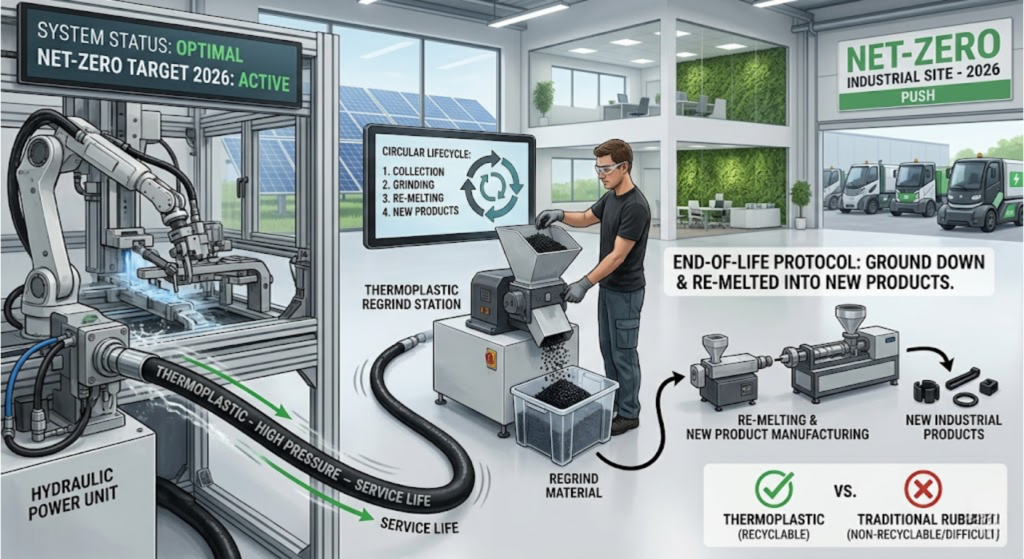
With the 2026 push toward “Net-Zero” industrial sites, high-pressure hoses are now designed with a Circular Lifecycle. New thermoplastic-based high-pressure hoses are replacing traditional vulcanized rubber in many sectors. Unlike rubber, which is difficult to recycle, these thermoplastic versions can be ground down and re-melted into new industrial products at the end of their service life. This reduces the carbon footprint of a fleet and simplifies waste management for large-scale operations.
Conclusion: Future-Proofing the Industrial Backbone
The high-pressure hydraulic hose of 2026 is much more than a component; it is a sophisticated sensor and a marvel of materials science. For businesses operating in Delhi, Chandigarh, or any global industrial hub, upgrading to these next-gen hoses means more than just preventing leaks. It means embracing a future of automated safety, minimized downtime, and superior machine performance. As we move deeper into the decade, the integration of these smart, strong, and sustainable fluid solutions will be the hallmark of every successful industrial enterprise.
high-pressure hoseshigh-pressure hoseshigh-pressure hoseshigh-pressure hoseshigh-pressure hoseshigh-pressure hoseshigh-pressure hoses