
The Lifeline of Heavy Machinery
In the modern industrial landscape, fluid power is the muscle behind almost every major mechanical operation. Whether it is a massive construction excavator, an aerospace landing gear system, or automated manufacturing robotics, these machines rely on a singular, critical component to function: the high pressure hydraulic hose.
Without a reliable high pressure hydraulic hose, the immense power generated by hydraulic pumps cannot be transferred to the actuators that do the actual work. As we push the limits of industrial efficiency in 2026, understanding the anatomy, selection criteria, and maintenance of a high pressure hydraulic hose is more critical than ever for preventing costly downtime and ensuring workplace safety.
What is a High Pressure Hydraulic Hose?
At its core, a high pressure hydraulic hose is not just a simple rubber pipe. It is a highly engineered conduit built to withstand extreme internal pressures, immense temperature fluctuations, and severe external abrasions. Every high pressure hydraulic hose is designed to bend and flex, allowing moving parts on machinery to operate freely without severing the flow of pressurized hydraulic fluid.
The Anatomy of a High Pressure Hydraulic Hose
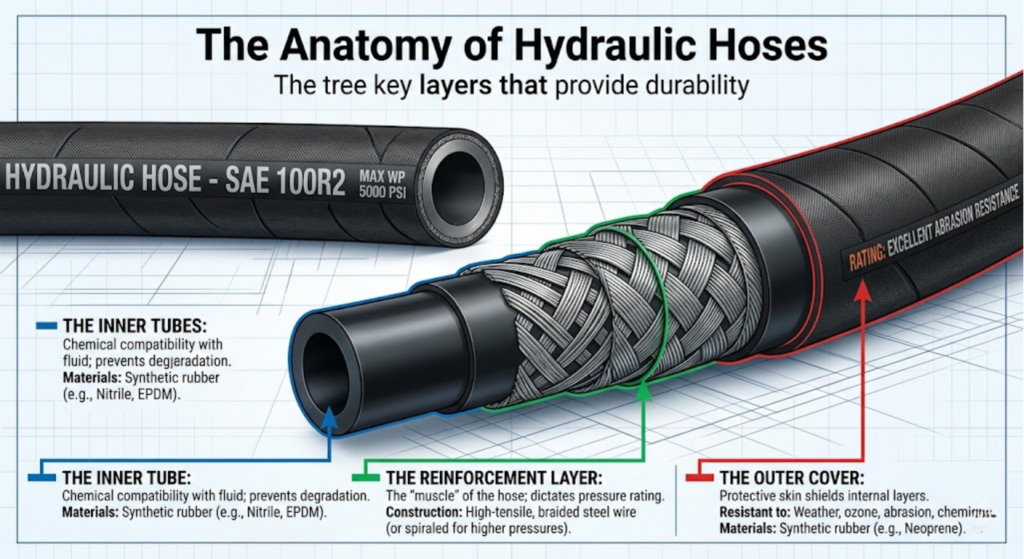
To withstand operational pressures that frequently exceed 5,000 PSI (Pounds per Square Inch), a high pressure hydraulic hose is constructed using three primary layers:
The Inner Tube: This is the innermost layer that makes direct contact with the hydraulic fluid. It is typically made from synthetic rubber, PTFE (Teflon), or thermoplastic, chosen specifically for its chemical compatibility with the fluid being used.
The Reinforcement Layer: This is the “muscle” of the high pressure hydraulic hose. It surrounds the inner tube and usually consists of multiple layers of braided or spiraled high-tensile steel wire. Spiral wire designs are specifically used for the most extreme high-impulse applications.
The Outer Cover: Designed for protection, this layer shields the reinforcement from weather, ozone, UV rays, chemicals, and mechanical abrasion.
Common Types and Specifications (Table)
To optimize your system, you must match the hose to the specific standard required. The Society of Automotive Engineers (SAE) classifies different types of hoses. Below is an overview of common SAE ratings for a high pressure hydraulic hose:
| SAE Standard | Construction Type | Typical Max Pressure Rating | Primary Application |
|---|---|---|---|
| SAE 100R2 | Two-wire steel braid | Up to 6,000 PSI | General high-pressure machinery, tractors, and loaders. |
| SAE 100R12 | Four-wire steel spiral | Up to 4,000 PSI (Heavy Duty) | High-impulse applications, heavy construction equipment. |
| SAE 100R13 | Multiple steel wire spirals | Up to 5,000 PSI (Extreme) | Severe heavy-duty equipment subject to extreme pressure surges. |
| SAE 100R15 | Six-wire steel spiral | Up to 6,000 PSI (Constant) | High hydrostatic drives, mining equipment, and extreme logging machinery. |
How to Choose the Right High Pressure Hydraulic Hose
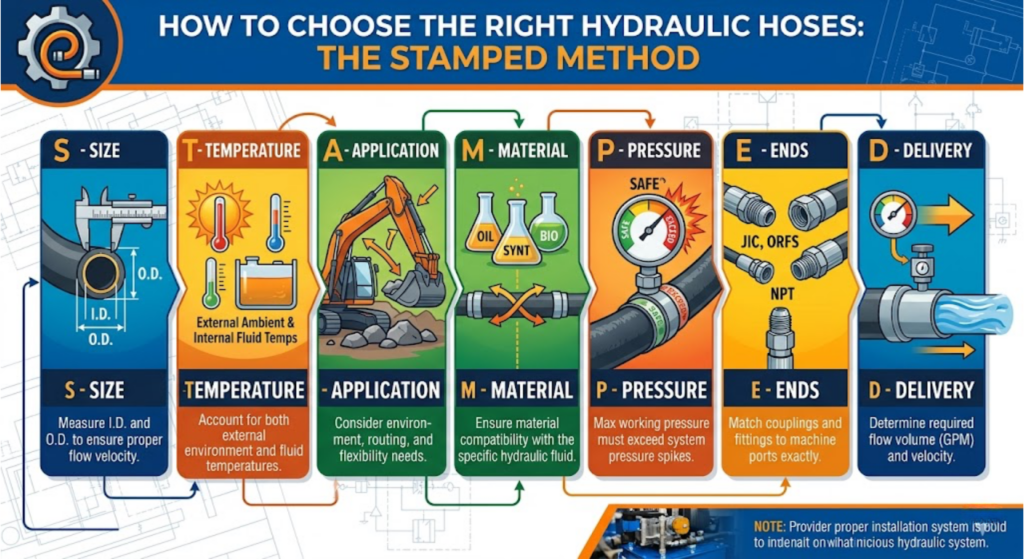
Selecting the incorrect high pressure hydraulic hose for your machinery can lead to catastrophic failure. Industry professionals use the STAMPED method to ensure optimal selection:
S – Size: Both the inside diameter (ID) and outside diameter (OD) must be exact to maintain proper fluid velocity.
T – Temperature: The high pressure hydraulic hose must withstand both the ambient temperature of the environment and the internal temperature of the fluid.
A – Application: Consider where the hose will be used. Will it face severe bending, routing in tight spaces, or extreme abrasion?
M – Material: Ensure the inner tube material is chemically compatible with the specific hydraulic fluid (e.g., petroleum-based vs. water-glycol).
P – Pressure: The working pressure of the high pressure hydraulic hose must be equal to or greater than the maximum system pressure, including pressure spikes.
E – Ends: The couplings and fittings must perfectly match the hose and the machine’s ports.
D – Delivery: Volume and velocity requirements of the fluid being transferred.
Safety and Maintenance
Because a high pressure hydraulic hose operates under immense force, a failure is not just an inconvenience—it is a severe safety hazard. High-pressure fluid leaks can cause fluid injection injuries, which are severe medical emergencies.
Routine maintenance of your high pressure hydraulic hose is mandatory. Inspect hoses daily for signs of wear, such as cracked covers, exposed wire reinforcement, twisting, or weeping at the fittings. A high pressure hydraulic hose does not last forever; proactive replacement before a blowout occurs is the most cost-effective and safe strategy for any industrial operation.
Safety and Maintenance
Because a high pressure hydraulic hose operates under immense force, a failure is not just an inconvenience—it is a severe safety hazard. High-pressure fluid leaks can cause fluid injection injuries, which are severe medical emergencies.
Routine maintenance of your high pressure hydraulic hose is mandatory. Inspect hoses daily for signs of wear, such as cracked covers, exposed wire reinforcement, twisting, or weeping at the fittings. A high pressure hydraulic hose does not last forever; proactive replacement before a blowout occurs is the most cost-effective and safe strategy for any industrial operation.
Conclusion
Understanding the complexities of fluid power transmission is key to modern industrial success. By selecting the correct high pressure hydraulic hose, utilizing the STAMPED method, and adhering to strict maintenance schedules, you ensure that your heavy machinery operates safely, efficiently, and profitably for years to come.