In the demanding environment of offshore drilling, the integrity of fluid transfer systems is paramount. Oil and fuel transfer hoses for offshore rigs serve as the vital arteries of a platform, facilitating the movement of hydrocarbons, bunkering fuels, and drilling fluids between supply vessels and the rig. Because these operations occur in some of the most volatile conditions on earth, choosing the right equipment is not just a matter of efficiency—it is a matter of safety and environmental stewardship.
Why Quality Matters: The Role of Oil and Fuel Transfer Hoses for Offshore Rigs
Offshore operations face a unique trifecta of challenges: high pressure, corrosive saltwater, and constant mechanical motion. Oil and fuel transfer hoses for offshore rigs are specifically engineered to withstand these stresses. Unlike standard industrial hoses, marine-grade transfer lines must resist UV degradation, ozone exposure, and the abrasive nature of the sea floor or rig structure.
Failure to use specialized oil and fuel transfer hoses for offshore rigs can lead to catastrophic leaks. A single rupture can result in millions of dollars in lost product, severe environmental fines, and immediate danger to the crew. Therefore, understanding the specifications of these hoses is the first step toward a secure operation.
Types of Hoses Used in Offshore Environments
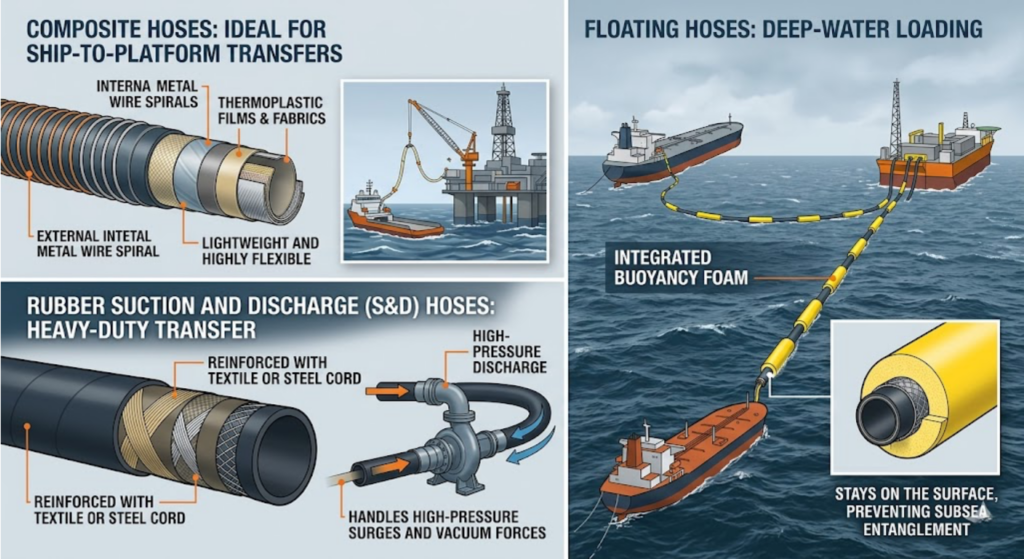
Not all oil and fuel transfer hoses for offshore rigs are created equal. Depending on the specific application—be it suction, discharge, or floating transfer—different constructions are required.
Composite Hoses: These are highly flexible and lightweight, making them ideal for ship-to-platform transfers.They consist of multiple layers of thermoplastic films and fabrics held together by internal and external wire spirals.
Rubber Suction and Discharge (S&D) Hoses: These heavy-duty oil and fuel transfer hoses for offshore rigsfeature reinforced textile or steel cord layers. They are designed to handle high-pressure surges and the vacuum forces of suction.
Floating Hoses: Used primarily in deep-water loading, these hoses have integrated buoyancy foam to stay on the surface, preventing entanglement with subsea equipment.
Technical Specifications and Standards
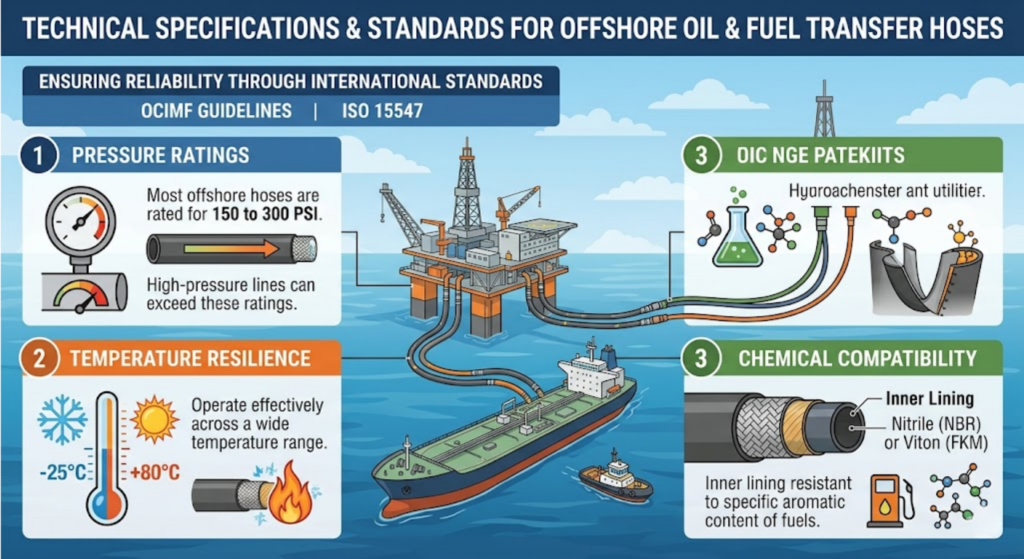
To ensure reliability, oil and fuel transfer hoses for offshore rigs must adhere to international standards such as OCIMF (Oil Companies International Marine Forum) guidelines and ISO 15547. These standards dictate:
- Pressure Ratings: Most offshore hoses are rated for at least 150 to 300 PSI, though high-pressure lines can exceed this.
Temperature Resilience: They must operate effectively in temperatures ranging from -25°C to +80°C.
Chemical Compatibility: The inner lining (often Nitrile or Viton) must be resistant to the specific aromatic content of the fuels being moved.
When sourcing oil and fuel transfer hoses for offshore rigs, operators must verify that the hose assembly—including the couplings and flanges—matches the pressure rating of the hose itself. A hose is only as strong as its weakest connection.
Detailed Technical Comparison
To ensure operational success, engineers must match the hose type to the specific fluid and environmental conditions. The following table provides a comprehensive breakdown of the most common oil and fuel transfer hoses for offshore rigs.
| Feature/Type | Composite Transfer Hose | Heavy-Duty Rubber S&D | Floating Bunkering Hose | Submarine Armored Hose |
|---|---|---|---|---|
| Primary Use | Ship-to-platform fuel transfer | Drilling mud & crude suction | Mid-water fuel bunkering | Subsea manifold connections |
| Lining Material | PTFE / Polyamide films | High-grade Nitrile (NBR) | Synthetic Elastomer | Fluoroelastomer (Viton) |
| Reinforcement | Internal/External wire helix | Multiple steel cord plies | High-tensile textile/steel | Double-wire steel armor |
| Temp Range | -30°C to +100°C | -25°C to +80°C | -20°C to +70°C | -35°C to +90°C |
| Max Pressure | 15 Bar (217 PSI) | 20 Bar (290 PSI) | 15 Bar (217 PSI) | 40+ Bar (580+ PSI) |
| Key Advantage | Extreme flexibility/Weight | Vacuum resistance | Prevents propeller snagging | High crush resistance |
Critical Engineering Standards: The OCIMF Benchmark
When procuring oil and fuel transfer hoses for offshore rigs, documentation is as important as the hardware. The gold standard for these components is the OCIMF (Oil Companies International Marine Forum) guidelines. These standards ensure that the hose has undergone rigorous testing, including:
- Burst Pressure Testing: Ensuring the hose can withstand at least four times its rated working pressure (4:1 safety factor).
Bending Radius Verification: Confirming that the hose can be coiled without kinking, which is vital for storage on tight rig decks.
Electrical Continuity: In fuel transfer, static electricity is a major fire risk. Oil and fuel transfer hoses for offshore rigs are tested to ensure they either conduct or dissipate static charges safely to the grounding system.
Vacuum Resistance: Specifically for suction hoses, this ensures the internal lining won’t collapse and choke the flow during high-volume pumping.
Maintenance Protocols and Lifespan Management
Even the most robust oil and fuel transfer hoses for offshore rigs have a shelf life. Most safety officers recommend a retirement age of 3 to 5 years, regardless of visual appearance. To maximize the ROI on these expensive assets, rigs follow a strict maintenance cycle:
The “Six-Month” Rule: Every six months, hoses should be laid out on a flat surface for a “visual health check.” Operators look for “cover tears,” which allow saltwater to reach the steel reinforcement, leading to “hidden” rust.
Hydrostatic Pressure Tests: Annually, the hose is filled with water and pressurized to 1.5× its working pressure to check for leaks or permanent elongation.
Cleaning and Flushing: After transferring crude or heavy fuels, the oil and fuel transfer hoses for offshore rigs must be flushed with cleaning agents to prevent the internal lining from becoming “coked” or brittle.
The 2026 Innovation: Smart Hose Systems
The latest trend in the offshore sector is the integration of IoT into oil and fuel transfer hoses for offshore rigs. Modern “Smart Hoses” feature embedded sensors that monitor:
Wall Thinning: Ultrasonic sensors detect internal erosion from abrasive drilling fluids.
Real-time Pressure Spikes: Alerts the control room immediately if a surge threatens the hose’s integrity.
GPS Tracking: Ensures that floating hoses are not drifting toward the rig’s propulsion or intake systems.
These advancements ensure that oil and fuel transfer hoses for offshore rigs are no longer “dumb” rubber tubes but sophisticated components of the digital oilfield.
Conclusion: Investing in Reliability
In the offshore world, there is no room for “good enough.” Choosing the right oil and fuel transfer hoses for offshore rigs is a decision that impacts the safety of the crew and the health of the marine ecosystem. By understanding the technical requirements, adhering to OCIMF standards, and embracing new sensor technologies, operators can ensure that their fluid transfer remains seamless and secure.