In the competitive industrial landscape of 2026, operational efficiency is the cornerstone of profitability. While massive turbines and smart motors often steal the spotlight, a critical component of fluid and gas transfer is frequently overlooked: the hose system. Implementing energy efficient industrial hose systems is one of the most effective ways to reduce overhead, minimize carbon footprints, and protect equipment longevity.
A poorly designed hose assembly can act as a “parasitic” drain on your power grid, forcing pumps and compressors to work significantly harder to maintain flow. By focusing on energy efficient industrial hose systems, modern facilities can reclaim lost power and streamline production.
Why "Energy Efficient Industrial Hose Systems" Matter in 2026
In a typical manufacturing facility, fluid transfer systems account for approximately 20% to 30% of total energy consumption. When a hose is inefficient, it creates “friction loss”—resistance that occurs as a fluid moves against the internal wall of the conduit.
Transitioning to energy efficient industrial hose systems addresses this at the source. By reducing turbulence and pressure drops, these systems ensure that every kilowatt of power used by your pumps translates directly into productive movement.
The Core Components of Energy-Efficient Design
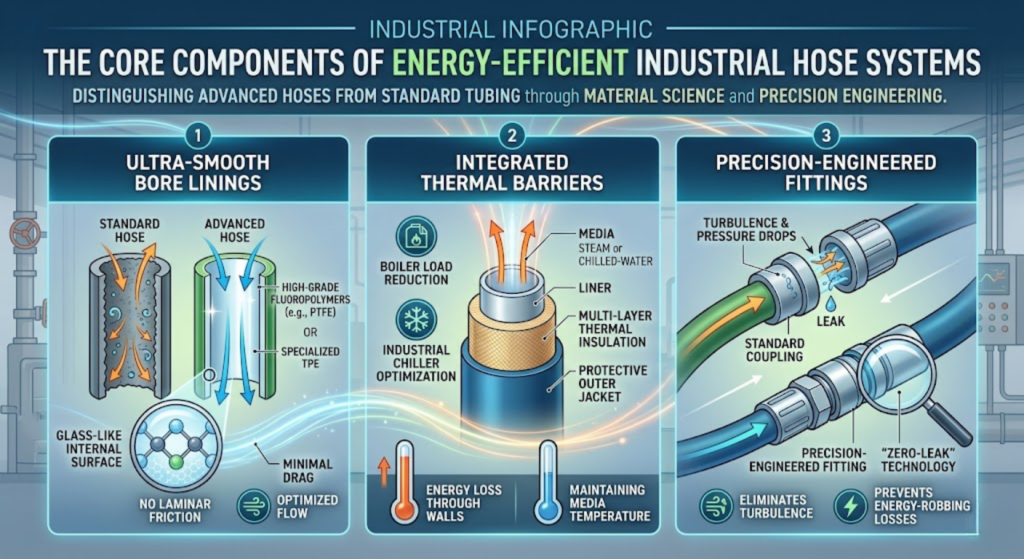
What distinguishes energy efficient industrial hose systems from standard industrial tubing? It comes down to advanced material science and precision engineering.
1. Ultra-Smooth Bore Linings
Standard hoses often have microscopic irregularities that create “laminar friction.” Modern energy efficient industrial hose systems utilize high-grade fluoropolymers (like PTFE) or specialized thermoplastic elastomers (TPE). These materials provide a glass-like internal surface, allowing liquids and gases to glide through with minimal drag.
2. Integrated Thermal Barriers
In steam or chilled-water applications, energy is often lost through the hose walls. High-performance energy efficient industrial hose systems feature multi-layer thermal insulation. By maintaining the media’s temperature from source to destination, these hoses reduce the load on boilers and industrial chillers.
3. Precision-Engineered Fittings
A single leak in a compressed air line can cost a facility thousands of dollars annually. Energy efficient industrial hose systems prioritize “zero-leak” coupling technology. These fittings are designed to eliminate the turbulence typically found at connection points, which is a major source of energy-robbing pressure drops.
Strategic Optimization for Industrial Workflows
Simply buying the right hose isn’t enough; you must optimize the entire system architecture. To maximize the benefits of energy efficient industrial hose systems, consider these three strategies:
Right-Sizing for Flow Velocity
One of the most common errors is using a hose with an internal diameter (I.D.) that is too small for the required volume. This creates a “choke point” that spikes energy demand. Energy efficient industrial hose systems must be sized so that fluid velocity stays within optimal ranges, preventing the exponential energy loss associated with high-velocity friction.
Minimizing Bends and "Dead Legs"
Every 90-degree bend in a hose adds significant resistance. Energy efficient industrial hose systems utilize materials with superior bend radii, allowing for shorter, more direct routing. Additionally, removing “dead legs”—sections of the system where fluid remains stagnant—prevents unnecessary pressure fluctuations.
Proactive Pressure Monitoring
Modern energy efficient industrial hose systems often incorporate smart sensors. These IoT-enabled devices monitor pressure in real-time, alerting maintenance teams to internal degradation before it impacts energy consumption.
Economic Benefits and ROI
Investing in energy efficient industrial hose systems offers a rapid Return on Investment (ROI), often realized within 12 to 18 months. The savings come from several key areas:
Lower Utility Bills: Reduced demand on electric motors and compressors.
Extended Equipment Life: Pumps running at lower RPMs experience less wear and tear.
Reduced Downtime: High-efficiency hoses are typically more durable, leading to fewer unplanned maintenance stops.
Industry Insight: In 2026, many regional governments offer “Green Credits” for facilities that document a reduction in pneumatic and hydraulic energy waste through the adoption of energy efficient industrial hose systems.
The Path Forward: Sustainability through Connectivity
As we move toward a more sustainable industrial future, the humble hose has evolved into a high-tech asset. By choosing energy efficient industrial hose systems, you are not just buying a conduit; you are optimizing a vital artery of your production process.
The combination of smooth-bore linings, thermal protection, and precision sizing transforms energy efficient industrial hose systems from a simple utility into a strategic advantage. Audit your facility today—your bottom line, and the planet, will thank you.