
Choosing the best hose pipe for chemical transfer is more than just a procurement task; it is a critical safety decision. In industrial environments, the stakes are high. Using an incompatible hose can lead to catastrophic leaks, environmental contamination, and severe injury. As we navigate 2026, material science has advanced, providing more durable and specialized options than ever before.
In this guide, we will break down the essential factors for selecting the best hose pipe for chemical transfer, compare top-performing materials, and ensure your operations remain both efficient and safe.
Top Materials for Chemical Transfer Hoses
When searching for the best hose pipe for chemical transfer, you will likely encounter four primary materials. Each has distinct advantages depending on the application:
1. PTFE (Polytetrafluoroethylene)
Often referred to by the brand name Teflon, PTFE is widely considered the best hose pipe for chemical transfer when dealing with highly aggressive substances.
Pros: Virtually inert to almost all chemicals; handles extreme temperatures (−70°C to 260°C).
Best For: Strong acids, pharmaceuticals, and high-heat applications
2. UHMWPE (Ultra-High Molecular Weight Polyethylene)
UHMWPE is the “workhorse” of the chemical industry. It offers a balance of high chemical resistance and physical durability.
Pros: Excellent abrasion resistance and handles roughly 98% of common industrial chemicals.
Best For: General chemical processing and tank truck loading/unloading.
3. Composite Hoses
Composite hoses are unique because they are constructed from multiple layers of film and fabric. This design makes them the best hose pipe for chemical transfer when flexibility is a priority.
Pros: Extremely lightweight and flexible; multi-layer construction provides a “fail-safe” barrier.
Best For: Ship-to-shore transfers and railcar loading.
4. EPDM (Ethylene Propylene Diene Monomer)
While more limited than PTFE, EPDM is a cost-effective solution for specific environments.
Pros: Excellent resistance to weather and heat.
Best For: Handling mild chemicals, ketones, and alcohols. Warning: Do not use with oils or hydrocarbons.
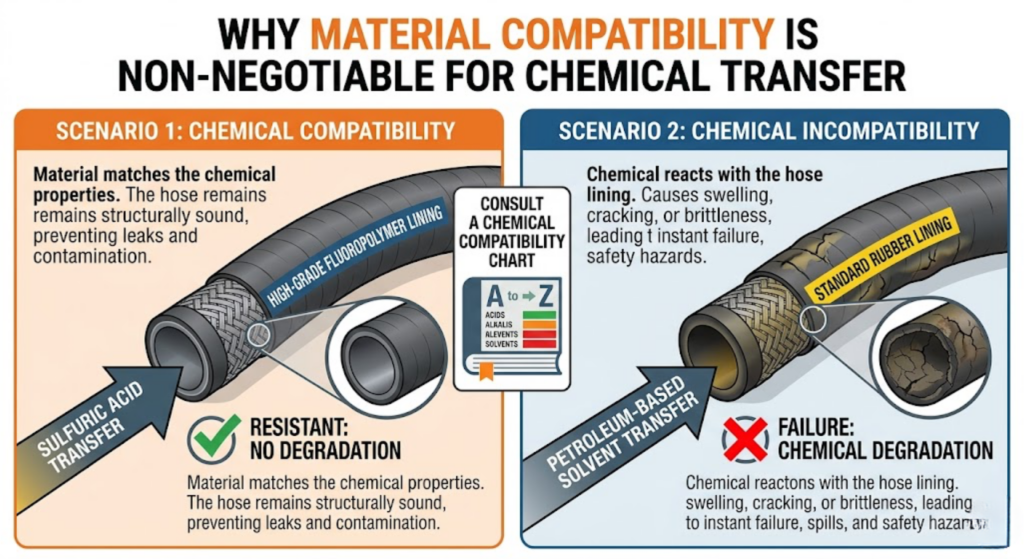
Key Features of the Best Hose Pipe for Chemical Transfer
To ensure you are investing in a high-quality product, look for these technical specifications:
| Feature | Importance |
|---|---|
| Working Pressure | Must exceed the maximum pump pressure to prevent bursting. |
| Bend Radius | Determines how tightly the hose can turn without kinking. |
| Static Dissipation | Vital for transferring flammable chemicals to prevent sparks. |
| Vacuum Rating | Necessary if the hose will be used for suction applications. |
Safety Standards and Maintenance
Selecting the best hose pipe for chemical transfer also involves looking at certifications. In 2026, industry standards like EN 12115 (for rubber hoses) and EN 13765 (for composite hoses) remain the benchmarks for safety and quality.
Maintenance Tips:
- Pre-use Inspection: Check for external abrasions, kinks, or soft spots.
Hydrostatic Testing: Perform annual pressure tests to ensure the integrity of the hose and couplings.
Proper Storage: Keep hoses away from direct sunlight and extreme temperatures when not in use to prevent UV degradation.
Conclusion: Making the Right Choice
Finding the best hose pipe for chemical transfer requires a deep understanding of your specific operational needs. While PTFE offers the broadest protection, UHMWPE or Composite hoses may offer better physical flexibility and value for your specific budget.
Always prioritize safety over initial cost. A premium hose designed for your specific chemical profile is an investment in your facility’s longevity and your team’s safety.
Expert Tip: When in doubt, always provide your chemical concentrations and operating temperatures to your supplier to confirm you are truly getting the best hose pipe for chemical transfer for your unique setup.