
A chemical hose is specially designed to safely transfer aggressive fluids such as acids, solvents, and industrial chemicals. These hoses are built using durable, chemical-resistant materials to prevent corrosion and leakage. Choosing the right chemical hose ensures efficient operations, enhanced safety, and long-lasting performance across various industrial and manufacturing applications.
In the high-stakes world of industrial fluid transfer, a hose is never “just a hose.” In 2026, as chemical processing becomes more specialized and safety regulations tighten, selecting the right chemical-resistant rubber hose is the difference between a seamless operation and a catastrophic failure.
Whether you are handling aggressive solvents, corrosive acids, or high-purity pharmaceuticals, here is your definitive guide to the types and uses of chemical-resistant rubber hoses in 2026.
Why "Chemical Resistance" is More Complex in 2026
Chemical resistance isn’t a binary “yes” or “no.” It depends on the molecular interaction between the hose liner and the substance being transported. Modern hoses are engineered to prevent:
Swelling: Where the rubber absorbs chemicals and loses structural integrity.
Leaching: Where hose materials contaminate the fluid (critical in pharma and food).
Permeation: Where gas or liquid molecules seep through the hose wall.
Core Types of Chemical Resistant Hoses
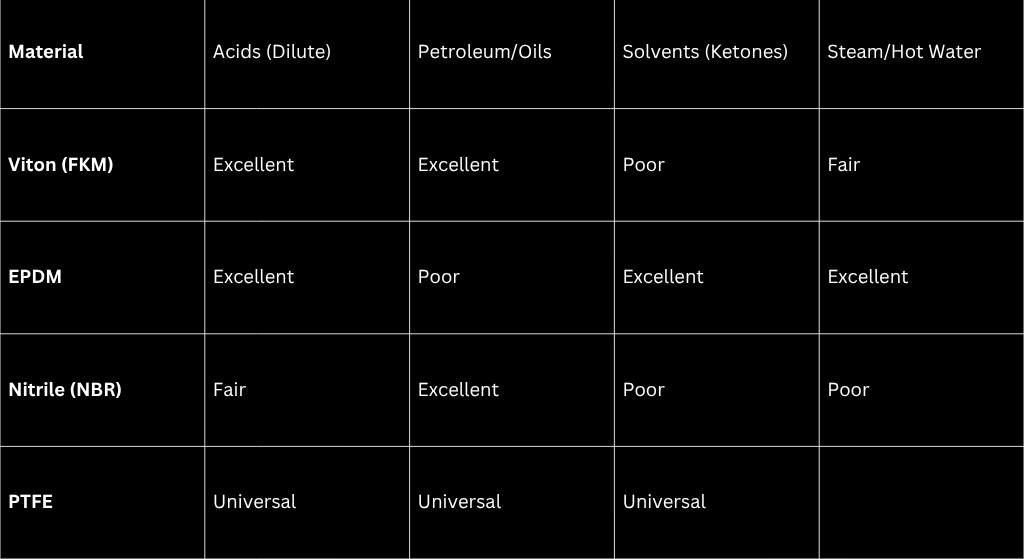
The “Big Three” materials dominating the market in 2026 are Viton (FKM), EPDM, and PTFE. Here is how they stack up:
1. Viton (FKM) Hoses
Viton remains the gold standard for aggressive hydrocarbon environments.
Best For: Oils, fuels, lubricants, and most mineral acids.
Temperature Range: −20°C to +250°C (−4°F to +482°F).
Key Use Case: Refineries and chemical plants handling aromatic hydrocarbons where other rubbers would turn to mush.
2. EPDM (Ethylene Propylene Diene Monomer)
The versatile workhorse of the industry.
Best For: Polar substances like water, steam, alcohols, and ketones (like Acetone).
Temperature Range: −50°C to +150°C (−58°F to +302°F).
Key Use Case: HVAC systems, outdoor applications (excellent UV/Ozone resistance), and general acid/alkali transfer.
3. PTFE (Polytetrafluoroethylene) / UHMW-PE
While technically a fluoropolymer liner inside a rubber jacket, these are often categorized together for their near-universal resistance.
Best For: Almost all known chemicals, including highly corrosive “super-acids.”
Temperature Range: −200°C to +260°C (−328°F to +500°F).
Key Use Case: Pharmaceutical manufacturing and high-purity labs where zero contamination is required.
2. Industry Trends: What’s New in 2026?
Smart Monitoring & Iot
We are seeing the rise of Smart Hoses. These include embedded sensors that monitor internal pressure, temperature, and wall thinning in real-time, alerting operators to potential leaks before they occur.
The “Hybrid” Construction
To balance flexibility with extreme resistance, many 2026 hoses use a UHMW-PE (Ultra-High Molecular Weight Polyethylene) liner. This provides the chemical “bulletproofing” of plastic with the bend radius and vibration dampening of a traditional rubber hose.
Sustainability & Bio-Rubbers
Manufacturers are increasingly incorporating bio-based elastomers and recycled reinforcement textiles to meet new “Green Industrial” standards without sacrificing the 200 PSI+ pressure ratings required for heavy industry.
How to Choose the Right Chemical Hose
Before ordering, always use the S.T.A.M.P.E.D. method:
Size: ID, OD, and length
Temperature: Of both the medium and the external environment.
Application: Is it suction (vacuum) or discharge (pressure)?
Material: What specific chemical is being conveyed? (Consult a 2026 compatibility chart).
Pressure: Does it handle surges?
Ends: Do you need camlocks, flanges, or threaded fittings?
Delivery: Specialized testing or certifications (FDA, EPA, ISO).
Chemical hose Chemical hose Chemical hose Chemical hoseChemical hose Chemical hose Chemical hose Chemical hose Chemical hose