
Industrial Rubber Hose Selection Guide 2026: The Master Resource for high-stakes manufacturing, construction, and energy. While massive turbines grab the headlines, these hoses are the unbeatable arteries of modern industry.
Whether transporting volatile chemicals or high-pressure steam, selecting the right hose is vital. This guide ensures superior safety, helping you master the materials and standards necessary to prevent dangerous failures.
What Exactly is an Industrial Rubber Hose?
At its simplest, an industrial rubber hose is a flexible tube designed to transport fluids, gases, or solids. Unlike your garden hose at home, these are engineered to withstand extreme conditions—think scorching temperatures, corrosive acids, and pressures that would burst a standard pipe. This Industrial rubber hose selection guide 2026 highlights that material integrity is the foundation of site safety.
The Anatomy of a Hose
Most industrial hoses aren’t just a single layer of rubber. They are “sandwiches” of engineering, typically consisting of three main layers:
The Tube (Inner Lining): The innermost layer that touches the material. It must be chemically compatible with the media.
The Reinforcement: The “muscle” of the hose, usually braided textile or high-tensile wire.
The Cover (Outer Layer): Protects against UV rays, ozone, abrasion, and oils.
Common Types of Industrial Hoses
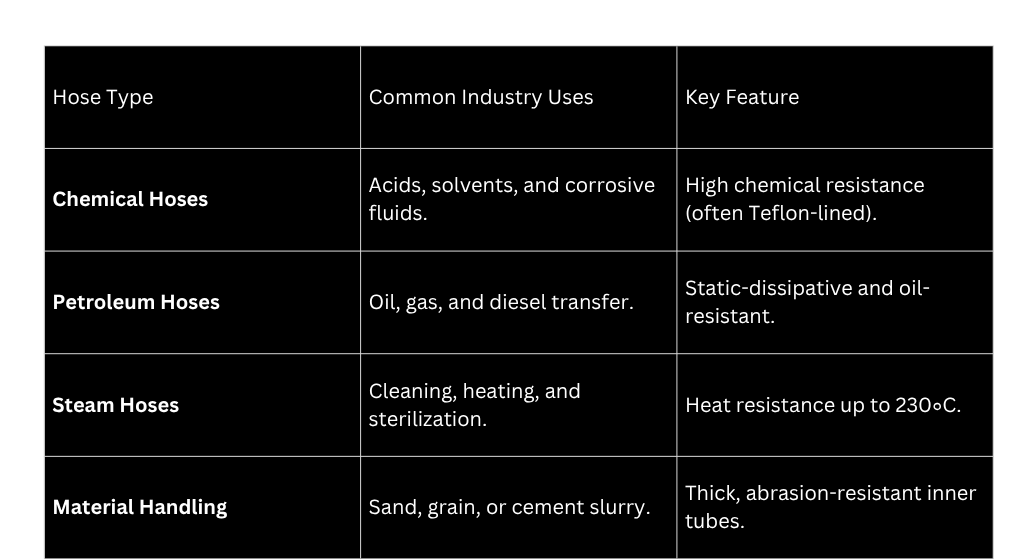
In 2026, material science has given us more specialized options than ever. Use this Industrial rubber hose selection guide 2026 to identify which category fits your facility:
How to Choose the Right Hose (The STAMPED Method)
Choosing the wrong hose isn’t just a mistake—it’s a safety hazard. Any comprehensive Industrial rubber hose selection guide 2026 will recommend the STAMPED acronym to ensure a perfect match:
Size: Inner diameter, outer diameter, and total length.
Temperature: Both the internal media and the external environment.
Application: How and where will the hose be used?
Material: What is being conveyed? (Air, water, hazardous chemicals?)
Pressure: What are the working and surge pressures?
Ends: What kind of couplings or fittings are required?
Delivery: Is there a specific volume or flow rate requirement?
Following this Industrial rubber hose selection guide 2026 checklist prevents premature failure and ensures operational efficiency.
Why Rubber Still Rules in 2026
Even with the rise of advanced thermoplastics, rubber remains the gold standard. Its natural elasticity, ability to absorb vibration, and resilience under repeated bending make it indispensable. As noted in this Industrial rubber hose selection guide 2026, rubber’s fatigue resistance is still unmatched for heavy-duty applications.
Safety and Maintenance
Never wait for a leak to happen. Regular inspections for cracks, “blistering” (bubbles on the cover), or leaks at the coupling are essential. By adhering to the standards in our Industrial rubber hose selection guide 2026, you can extend the service life of your equipment and protect your team.